





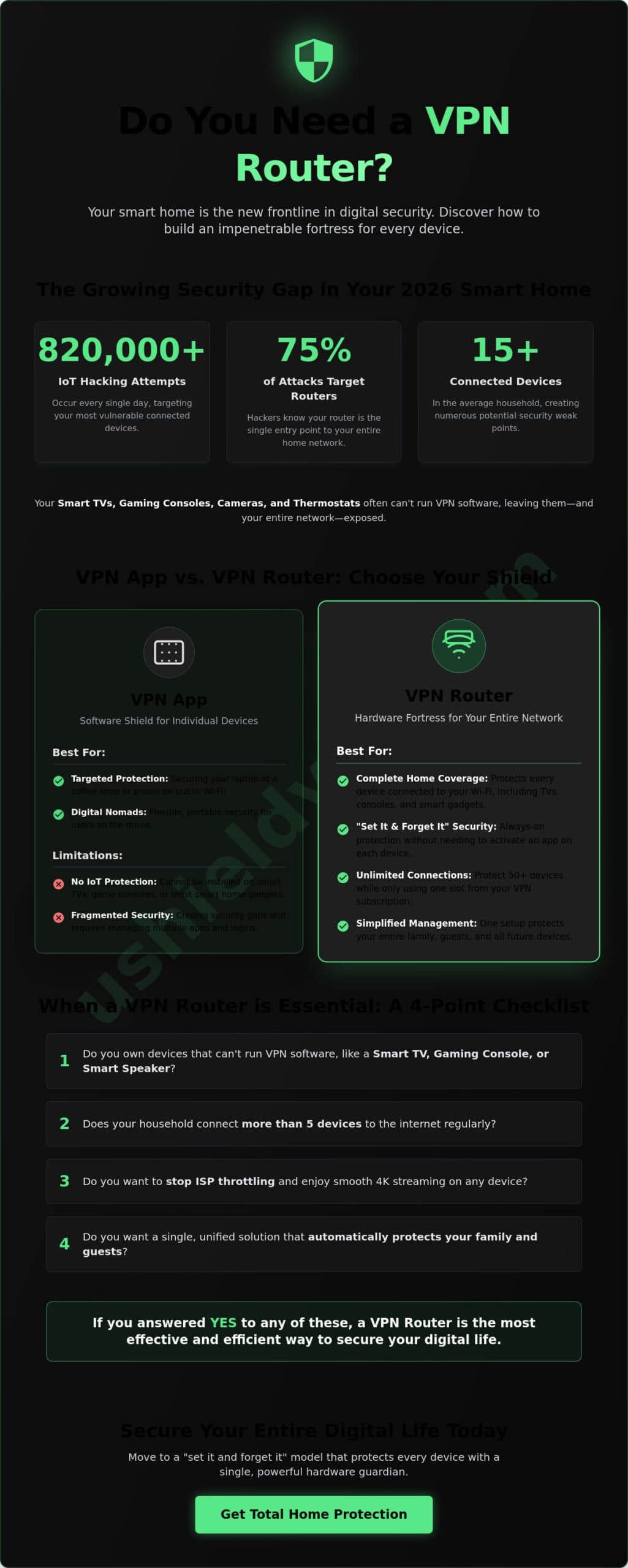
Your smart fridge might be the weakest link in your digital fortress. In 2026, over 820,000 IoT hacking attempts occur every single day; routers are the primary target in 75 percent of those attacks. You likely already use encryption on your laptop, but you are probably asking: do I need a VPN router to protect the rest of my home? It is a vital question when your Smart TV, gaming console, and thermostat are constantly broadcasting your data to the open web.
We understand the exhaustion of fragmented security. Managing separate apps for a dozen different devices is a chore. Most smart home gadgets do not even support native VPN software. This guide will show you how to close that gap effortlessly. You will discover if your network requires a dedicated hardware solution and how to achieve total home privacy with one “set it and forget it” tool. We will break down the 2026 security landscape, from WireGuard performance to new global regulations, to help you build a silent, powerful guardian for your digital life.
Key Takeaways
- Identify hidden vulnerabilities in your smart home. Secure IoT devices that cannot run traditional security software.
- Audit your connected devices to answer the question, “do I need a VPN router.” Network-wide encryption is the most efficient choice for households with over five devices.
- Compare the precision of a VPN app with the blanket protection of a router. Understand which solution fits your mobile versus stationary hardware needs.
- Eliminate ISP data throttling and performance lag. Modern encryption protocols now support high-velocity 4K streaming across your entire network.
- Simplify your digital life with pre-configured hardware. Move to a “set it and forget it” model that protects every device with a single, unified subscription.
The Growing Security Gap in Your 2026 Smart Home
Your home is no longer just a place to live. It is a complex digital ecosystem. In 2026, the average household connects over 15 devices to the internet. Most of these gadgets are silent, unprotected, and vulnerable. Hackers are shifting their focus. They don’t just target your banking password on your laptop. They look for the path of least resistance. This often leads them to your smart doorbell, baby monitor, or connected thermostat. These devices are the new front line of digital defense.
An unprotected smart camera is an open door. Once a bad actor gains access to one IoT device, they can move laterally through your entire network. They can see what you see. They can access your private files. Your Internet Service Provider (ISP) is also watching. They track every connection from your smart fridge to your gaming console. This data is often sold or used to throttle your bandwidth. A Virtual Private Network (VPN) is the standard defense against this intrusion. However, traditional apps only protect the device they are installed on. This creates a fragmented security landscape that leaves your most vulnerable hardware exposed.
Why Smart TVs and IoT are the Weakest Link
Smart TVs are central to modern entertainment, yet they are notoriously insecure. Most models do not support native VPN applications. They lack the processing power to handle heavy encryption on their own. This makes them easy targets. If a hacker compromises your TV, they are inside your local network. From there, they can target your phones and computers. A single weak link puts everything at risk. This is a primary reason why many homeowners ask: do I need a VPN router to secure the perimeter?
The Problem with App-Based Security
Managing security across 15 different devices is exhausting. You have to remember logins. You have to ensure every app is updated. Security failures often happen because a background update disabled an app without warning. Guest devices add another layer of risk. When friends connect to your Wi-Fi, they bring their own vulnerabilities into your home. App-based security cannot protect what it cannot be installed on. Instead of questioning each individual device, the real question becomes: do I need a VPN router to simplify the entire process? You need a solution that works at the source. A hardware-based approach ensures that every byte of data leaving your home is encrypted before it ever hits the open web.
VPN App vs. VPN Router: Understanding the Difference
Choosing between an app and a router depends on your lifestyle. A U Shield VPN App is a software shield for a specific device. You install it, log in, and toggle it on. It is excellent for protecting your laptop at a coffee shop or your phone on public Wi-Fi. But for a complete home environment, an app often falls short. It leaves gaps that hackers can exploit.
A VPN router is a hardware-based solution. It encrypts your entire internet connection at the source. This eliminates the need to install software on every individual gadget. It also addresses significant smart home security risks by covering devices that cannot run apps. When considering do I need a VPN router, think about the “always-on” advantage. You never have to remember to turn on your VPN. If your router is on, your family is protected. It is a silent guardian that works in the background.
One of the biggest benefits is the unlimited connection capacity. Most VPN providers limit how many devices you can connect at once. A VPN router counts as just one connection. Yet, it can protect 50 or more devices simultaneously. This makes it a cost-effective and powerful guardian for modern households. If you have a growing number of connected devices, you might ask: do I need a VPN router to manage them all? The answer lies in the efficiency of a single, unified solution. For a deeper look at the latest hardware options, our guide to choosing a router with built in vpn support covers the top Wi-Fi 7 models and WireGuard protocols available in 2026.
When an App is Enough
Apps are the right choice for digital nomads. If you spend your days in co-working spaces, you need portable protection. They are also ideal for users who only need to secure a single workstation. If your primary goal is occasional geo-unblocking for a specific movie on your tablet, a standalone app works perfectly. It is a flexible tool for targeted privacy.
When a Router is Essential
A router becomes essential when your home is filled with tech. It is the only way to secure gaming consoles, smart speakers, and older hardware. Families with multiple users find routers much easier to manage. You set it up once. Every new device that joins your Wi-Fi is automatically encrypted. It is the ultimate “set and forget” privacy solution. For those who value total invisibility, a dedicated router provides a seamless way to secure your entire digital footprint. Households with several people sharing a network will find that a VPN router for multiple users is the most practical and scalable security upgrade available in 2026.
The ‘Do I Need a VPN Router?’ Decision Checklist
Deciding on a security upgrade doesn’t have to be guesswork. Your home network has likely grown faster than your ability to protect it. Most users start with a simple app. Eventually, the sheer volume of connected tech makes manual management impossible. Instead of guessing, use this checklist to answer the question: do I need a VPN router for my specific setup?
Evaluate your current environment by looking at these five key indicators. If these scenarios sound familiar, your current security strategy is likely outdated.
- Device count: Do you have more than five connected items? Between smartphones, tablets, and laptops, most families hit this limit quickly.
- Hardware check: Do you own a Smart TV, Apple TV, or Alexa? These devices are notorious for lacking native security software.
- Streaming and gaming: Do you frequently stream 4K content or play online games? High-bandwidth activities are the primary targets for ISP intervention.
- Technical patience: Are you tired of managing multiple apps? Toggling connections on every device is a friction point that leads to security lapses.
- Privacy goals: Do you want to hide your entire household’s activity from your ISP? Total invisibility requires encryption at the point of entry.
The 5-Point Home Security Audit
Audit your network with these three actionable steps. First, walk through your home and identify every device that cannot run a VPN app. This includes your smart lights, thermostats, and older gaming consoles. Second, monitor your internet speed during peak evening hours. If your Netflix quality drops while your raw speed tests remain high, your ISP is likely throttling your connection. Third, determine if you require network-wide VPN protection to cover guest devices and IoT hardware automatically. This audit removes the emotion from the decision and focuses on raw utility.
Interpreting Your Results
Your score reveals the best path forward. If you checked three or more boxes, a hardware solution is your best move. Some critics argue that a router creates a single point of failure. In reality, a central hub is a massive security win. It allows you to monitor and encrypt every byte of data from one interface. You no longer have to worry if your child’s tablet is protected or if your smart camera is broadcasting to the open web. Transitioning from individual apps to a unified home shield simplifies your life. It turns security into a background utility rather than a daily chore. If you find yourself constantly checking app status, it is time to ask: do I need a VPN router to finally reclaim my peace of mind?
Performance, Speed, and the Reality of Modern Encryption
Speed is the currency of the modern home. A common misconception suggests that encryption inevitably leads to lag. In 2026, this is simply no longer true. High-performance hardware has caught up with security demands. Many users hesitate and ask, do I need a VPN router if it slows down my 4K streaming? The reality is quite the opposite. Modern systems utilize WireGuard, the current leading protocol for velocity and performance. This allows your network to maintain peak speeds while keeping your data invisible to prying eyes.
Your ISP is often your biggest speed bottleneck. They use deep packet inspection to monitor your activity. If they detect high-bandwidth gaming or Netflix sessions, they often throttle your connection to manage their network load. A pre-configured VPN router hides this traffic entirely. By masking the type of data you use, you bypass these artificial limits. You get the speed you actually paid for. Hardware-level optimization ensures that encryption happens at the processor level. This significantly outperforms standard models that struggle with the heavy lifting of modern security protocols.
Server location also plays a critical role in your experience. A global network of high-velocity servers ensures you can always find a nearby connection. This proximity reduces the physical distance your data travels, which minimizes latency. When you use a dedicated hardware solution, you gain access to these premium pathways across your entire home. It is a level of performance that standalone apps on a crowded device simply cannot match.
Gaming and Streaming Without Lag
Competitive gaming requires low latency and a stable ping. Standard software apps can sometimes add “jitter” to your connection as they compete for your computer’s resources. A dedicated router connects directly to optimized, low-latency servers. This keeps your gameplay smooth and responsive. These systems also feature a built-in kill switch. If your VPN connection drops, the router instantly cuts internet access. This prevents your real IP address from leaking during a match or a movie. You enjoy unlimited data without the fear of mid-action buffering or privacy gaps.
Military-Grade Encryption at Home
Security is only as strong as its implementation. We use AES-256 encryption, which remains the global gold standard for data protection. Software-based encryption can be bypassed if the underlying operating system is compromised by malware. Hardware-level encryption is different. It is baked into the router’s firmware, making it significantly harder to penetrate. Modern routers also include built-in anti-trackers. These block malicious ads and tracking scripts before they even reach your devices. If you want a network that is both fast and impenetrable, explore our U Shield VPN Router configurations to see how we prioritize your performance.
Effortless Protection with Pre-Configured Hardware
Digital security should not feel like a second job. Many homeowners eventually ask, do I need a VPN router, only to be discouraged by the prospect of complex manual setups. Traditional networking often requires “flashing” firmware or navigating archaic interfaces. We have removed those barriers. The U Shield VPN Router arrives pre-configured and ready for immediate action. It is a professional-grade solution designed for the average user. You get absolute protection without the technical burden.
Managing a dozen different logins is a recipe for security gaps. With our unified system, one subscription secures your entire household. Whether you select a Monthly VPN Plan or an Annual VPN Plan, the result is the same: total network-wide encryption. You no longer need to worry about which device is protected. If a gadget connects to your Wi-Fi, it is instantly shielded. This unified approach turns your router into a silent, powerful guardian that operates in the background of your daily life.
Reliability is built into the hardware. Your router handles updates automatically, ensuring you are always protected against the latest 2026 cyber threats. You don’t need to check for patches or manually reboot your security layers. It is a “set it and forget it” solution that values your time. By choosing a dedicated hardware solution, you ensure that your home remains a fortress without requiring constant maintenance. This is the ultimate answer for anyone still wondering, do I need a VPN router to simplify their digital life.
The Plug-and-Play Experience
The transition to a secure home takes minutes, not hours. Unbox the device, connect it to your modem, and your entire network is secure. No technical expertise is required. Pre-configured hardware eliminates the risk of human error during setup. Manual configuration is often prone to leaks and misaligned settings. Our plug-and-play model ensures that every security protocol is optimized for speed and invisibility from the moment you power it on. It is peace of mind delivered in a single box. Learn more about why this zero-configuration approach makes the plug and play VPN router the best security move for households with multiple users in 2026.
Choosing Your Protection Plan
Long-term privacy is most effective when it is consistent. We offer flexible options to fit your needs, ranging from a Monthly VPN Plan to our high-value Annual VPN Plan. The annual option provides significant long-term savings for families committed to total network privacy. You receive a bundled hardware and software solution that works in perfect harmony. There are no hidden fees or complex tiers to navigate. Your next step is simple. Take control of your data and secure your home network today with a solution built for power and simplicity.
Secure Your Digital Future Today
Your home network is only as strong as its most vulnerable device. We have explored how IoT gadgets often lack basic protection and why managing fragmented apps leads to security fatigue. By moving encryption to the source, you create a silent, powerful guardian for every connected device in your household. It is the most efficient way to close the 2026 security gap for good.
When you ask, do I need a VPN router, you are really asking if your family’s privacy is worth a simplified, permanent solution. Our hardware provides military-grade encryption and 24/7 global server access without sacrificing performance. It is fully optimized for 4K streaming and gaming; your entertainment remains private and fast. You don’t have to be a technical expert to achieve total network-wide security. It just works.
Get the U Shield VPN Router for Plug-and-Play Security and reclaim your peace of mind. Protection should be effortless. Take the first step toward a simpler, safer digital life today.
Frequently Asked Questions
Is a VPN router worth it for a small apartment?
Yes. A VPN router is worth the investment because it secures every smart device regardless of your square footage. Even in a studio apartment, your smart TV, doorbell, and gaming console broadcast data that needs protection. It simplifies your digital life by consolidating security into one central hub. You gain peace of mind without managing a dozen different apps.
Will a VPN router work with my existing ISP modem?
Yes. You simply connect the VPN router to your ISP modem using a standard Ethernet cable. Your modem continues to provide the internet signal while the router handles the encryption for your home. This setup creates a secure tunnel for all your traffic. It is a reliable, high-performance way to upgrade your privacy without replacing your current provider’s hardware.
Does a VPN router slow down my internet speed?
Modern hardware minimizes the impact on your connection. While all encryption requires some processing power, our optimized processors handle the load with ease. You can still stream 4K content and play competitive games without noticeable lag. By masking your activity, it can even stop ISP throttling. This often results in a more consistent and stable browsing experience.
Can I still use different VPN locations on different devices?
No. The router establishes one global location for every device connected to its network. This ensures consistent protection across your entire home. If you need a different location for a specific task, you can briefly use a standalone app on that device. Most users find that a single, secure gateway is the most efficient way to manage their privacy.
What happens if the VPN connection drops on the router?
A built-in kill switch instantly cuts your internet access. This critical safety feature prevents your real IP address and unencrypted data from leaking to the open web. Your devices remain offline until the secure connection is restored. It acts as an automated guardian, ensuring you never transmit data over an unprotected line.
Is it better to buy a pre-configured router or set it up myself?
Pre-configured routers are the superior choice for reliability and speed. Manual setup is often frustrating and can lead to security gaps or hardware failure. A pre-configured solution arrives optimized for peak performance. You skip the technical hurdles and gain immediate, professional-grade protection the moment you plug it in.
How many devices can I connect to a single VPN router?
You can connect dozens of devices simultaneously. Most modern hardware handles 50 or more connections without a drop in performance. This is why many families ask, do I need a VPN router to protect their growing tech ecosystem. It covers everything from your smartphone to your smart fridge under one unified shield.
Do I need a special subscription for a VPN router?
Yes. You need an active service plan to power the encryption and access the global server network. When people ask, do I need a VPN router, they are often looking for the simplicity of our Monthly VPN Plan or Annual VPN Plan. These plans ensure your hardware stays updated against the latest 2026 threats while providing high-velocity access around the clock.
