

Over 54% of people using a VPN today do so to access their favorite movies and shows. However, with platforms now using AI to detect connection patterns, you are right to ask: is VPN safe for streaming in 2026? You want global access without the fear of a sudden account ban. You deserve high-speed playback without the frustration of a constant buffering wheel. We believe digital security should be effortless and invisible.
True safety involves more than just a masked IP. It requires securing the hardware you use to watch. Recent shifts like Utah’s S.B. 73 show that the regulatory landscape is changing quickly. This guide breaks down the technical reality of modern encryption and the hidden risks of free services. We will examine smart TV vulnerabilities and how to bypass ISP throttling for good. You will learn how the U Shield VPN App and our specialized VPN Router provide a powerful, silent guardian for your home network. Reclaim your digital freedom and enjoy high-speed, private streaming today.
Key Takeaways
- Understand why the question is VPN safe for streaming depends on both technical encryption and legal compliance.
- Stop ISP profiling. Bypass speed throttling to enjoy a smoother 4K viewing experience.
- Avoid the free VPN trap. Don’t trade your personal privacy for limited server access.
- Secure your Smart TV. Protect the weakest link in your home network from hardware vulnerabilities.
- Use a U Shield VPN Router. It’s a silent, comprehensive shield for every connected device.
Is Using a VPN Safe for Streaming? Separating Fact from Fiction
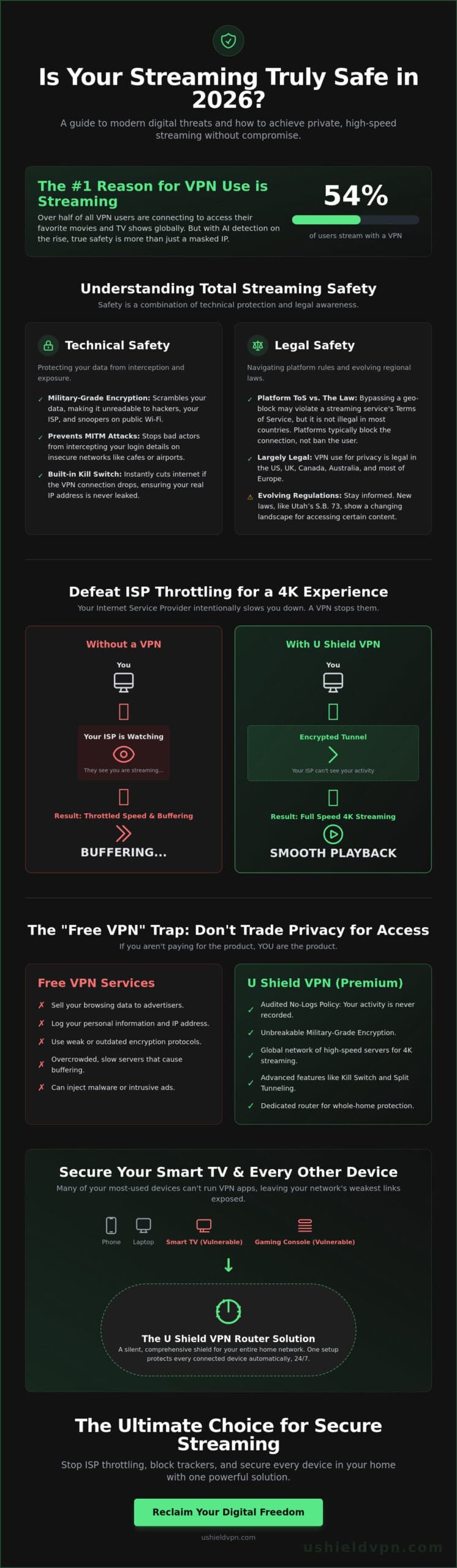
When you ask is VPN safe for streaming, you’re really asking two things. Is my personal data secure? And am I breaking the law? Safety isn’t a single checkmark. It’s a combination of robust encryption and following local regulations. Many people believe VPNs are only for hackers or those hiding illegal activity. This is a common myth. In 2026, a VPN is a standard privacy tool for the average person. It creates a private tunnel for your data. You get peace of mind. Your ISP can’t see your history. Hackers can’t touch your stream. It’s about taking control of your digital life.
Using a VPN is legal in the vast majority of countries, including the United States, United Kingdom, Canada, and Australia. These tools are designed to protect your privacy, not to facilitate crime. While some nations like North Korea or Belarus have full bans, most democratic regions recognize encryption as a fundamental right. It’s a professional way to manage your home network security without the technical headache.
Technical Safety: Encryption and Data Integrity
Security starts with the tunnel. To understand what a virtual private network (VPN) is, imagine an armored car for your data. Military-grade encryption scrambles your traffic, making it unreadable to outsiders. This prevents man-in-the-middle attacks. These attacks are common on public Wi-Fi networks in airports or hotels, where thieves intercept your login details. If you stream on the go, a secure tunnel is essential. The U Shield VPN App includes a built-in Kill Switch. This feature is vital for data integrity. If your connection drops for a second, the Kill Switch cuts your internet immediately. Your real IP address never leaks. Your identity stays hidden.
Legal Safety: Terms of Service vs. Local Laws
When users wonder is VPN safe for streaming, they often confuse platform rules with national laws. Bypassing a geo-block might violate a streaming service’s Terms of Service. Netflix or Disney+ might block a specific VPN IP address to protect their licensing deals. However, this is rarely a legal issue for the user. These platforms typically block the connection rather than banning the account.
Laws are evolving quickly. On May 6, 2026, Utah’s S.B. 73 took effect, focusing on age verification for specific sites. It’s the first US law to target VPN use for bypassing these gates. While enforcement of some provisions is paused until September 2026, it shows that staying informed is key. Before you connect, use this quick safety checklist:
- Confirm your country allows personal encryption tools.
- Review your streaming provider’s latest service agreement for VPN policies.
- Check if your local state has introduced specific age-verification requirements.
- Ensure your VPN provider has a verified no-logs policy.
By choosing a reliable service like our Annual VPN Plan, you ensure your streaming remains a private, safe, and high-speed experience.
The Invisible Guardian: How a VPN Secures Your Streaming Habit
Your ISP is a silent observer. They log every show you watch and every movie you search for. They know when you are home and what you enjoy. This isn’t just a privacy concern; it’s about data ownership. Advertisers pay for these behavioral profiles to target you more effectively. When you wonder is VPN safe for streaming, consider who currently has access to your habits. A VPN acts as a silent, powerful guardian for your home. It replaces your true IP address with a server IP. Streaming sites see the server, not your physical location. This simple layer of protection keeps your identity private and your data out of the hands of brokers.
Modern streaming requires more than just a connection. It requires invisibility. By masking your traffic, you prevent third-party sites from building a digital shadow of your life. This is especially important as 23% of global internet users have already turned to VPNs to reclaim their privacy in 2026. You deserve to watch what you want without being tracked across the web. It’s time to take the technical burden off your shoulders and focus on the content.
Stopping ISP Throttling and Data Harvesting
ISP throttling is the intentional slowing of internet service. Providers often target high-data traffic like 4K streaming to manage their network capacity. They see a Netflix or YouTube stream and cap the speed. This leads to the dreaded buffering wheel. Encryption solves this by hiding your specific activity. When your traffic is encrypted, the ISP sees data moving, but they cannot identify the source. If they don’t know you’re streaming, they can’t target your connection for slowdowns. You get the high-speed performance you pay for every month. This technical solution has a direct impact on your life. You enjoy seamless playback while keeping your data harvested by providers to a minimum. For a deeper understanding of how to bypass geo-blocks and stop ISP throttling for buffer-free 4K playback, our complete 2026 guide to VPN for streaming covers every device and scenario in detail.
Anti-Trackers and Malicious Ad Blocking
Streaming sites, especially unofficial or “free” platforms, are often riddled with trackers. These scripts follow your browsing even after you close the tab. They are invasive and compromise your security. Many of these sites also host malicious ads that can trigger background downloads or phishing attempts. A premium VPN includes built-in anti-tracking and ad-blocking features. It kills these scripts before they can execute on your device. Following FTC tips for choosing a VPN is a smart way to ensure your provider actually offers these protective layers. is VPN safe for streaming? It is when it actively blocks the scripts that want to exploit your hardware. This creates a cleaner, safer environment for your entertainment. You gain total privacy from ISP tracking and a faster, safer way to explore global content libraries.
The Free VPN Trap: Why No-Cost Services Are Often Unsafe
Free is a powerful word. It draws in about 44.2% of VPN users in the United States. However, maintaining a global network of servers is expensive. If you aren’t paying for the service, you are the product being sold. When asking is VPN safe for streaming, the answer changes drastically when the service is free. These providers often cut corners on security to maximize their profit margins. They lack the high-level encryption found in premium plans. This leaves your connection vulnerable to leaks. It puts your personal data at risk while you watch. Servers cost money. Without a subscription model, these companies must find alternative revenue streams to keep their hardware running. This often leads to compromised privacy and dangerous security gaps.
Malware is another significant risk. Many no-cost VPN apps are bundled with hidden tracking libraries. These scripts don’t just watch your streaming habits; they monitor your activity across your entire device. They turn your hardware into a data-harvesting tool for the provider. You think you’re getting a free movie. In reality, you’re giving away your digital identity. Premium protection removes this risk entirely. It allows you to focus on the entertainment while the security operates silently in the background.
How Free VPNs Monetize Your Streaming Data
Most free services monetize your data by selling logs to advertisers and brokers. They track the shows you watch and the platforms you visit. This information is highly valuable for building consumer profiles. Some services even inject their own ads directly into your streaming experience. This causes lag and ruins the immersion of your favorite show. Contrast this with the strict “No-Logs” policy of our Monthly VPN Plan or Annual VPN Plan. We don’t track you because we don’t need to sell your data. You pay for a service, and we provide absolute privacy. It’s a transparent, professional relationship that prioritizes your peace of mind.
Performance Bottlenecks and Security Gaps
Performance is where free services fail most visibly. They rely on overcrowded, limited server infrastructure. This leads to massive lag and constant buffering. Most free tiers also impose strict data caps. There is nothing more frustrating than having your connection cut off halfway through a movie’s climax. Furthermore, free VPN IP addresses are the first to be blacklisted. Streaming giants like Netflix use AI to identify and block these low-quality servers instantly. You end up with a “Proxy Error” instead of a movie. To avoid these interruptions, you should understand the unlimited data VPN benefits that come with a dedicated, professional service. Is VPN safe for streaming? Only when the provider has the resources to stay ahead of blocks and keep your data encrypted. Real security requires a commitment to quality that free apps simply cannot afford.
Securing the Big Screen: Safe Streaming on Smart TVs and IoT
Your Smart TV is a data-hungry machine. It sits in your living room, logging your habits and broadcasting them to third parties. Most users secure their laptops but leave their TVs exposed. This creates a massive security gap. When asking is VPN safe for streaming, you must look at the hardware itself. A TV without protection is a liability. It’s a silent observer that lacks the basic defenses of a modern smartphone. You deserve a home network that works for you, not for data brokers.
In 2026, the “Big Screen” is no longer just a display. It’s a sophisticated computer that often lacks essential security updates. Manufacturers prioritize new features over patching old vulnerabilities. This makes your TV a prime target for exploitation. Securing this device isn’t just about privacy; it’s about network integrity. You need a solution that operates silently in the background, protecting your family without requiring constant attention.
Why Your Smart TV is a Security Risk
Smart TVs rely on Automated Content Recognition (ACR) to build a profile of your viewing habits. They analyze every frame to see what you watch, from local news to private streaming. This data is valuable. It’s often transmitted over unencrypted connections. Most Smart TVs lack the processing power for deep security. They are built for speed and resolution, not for data integrity. This makes them the weakest link in your digital home. A vulnerability in your TV can serve as a gateway to your entire network. It allows bad actors to pivot from your entertainment system to your personal computer or smart home devices. Protection must be proactive. It must happen before the data leaves the device.
The Problem with App-Based Protection
Installing an app isn’t always an option. Many popular platforms like Roku and Apple TV don’t support native VPN software. Even on Android-based TVs, apps can be leaky. They might protect your Netflix stream while leaving background system data exposed. This creates a false sense of security. You need a solution that operates at the network level. A single point of protection ensures that every packet of data is encrypted before it ever reaches the web. This removes the technical burden from your devices. It puts the power back in your hands. By using a hardware-based solution, you bypass the limitations of proprietary operating systems. You gain total privacy without the need for individual app management. To take full control of your home security, you can buy a U Shield VPN Router to protect every connected screen instantly.
U Shield VPN: The Logical Choice for Secure, High-Speed Streaming
Security is only as strong as its weakest link. For most homes, that link is the router. If you are still asking is VPN safe for streaming, the answer lies in hardware-level protection. The U Shield VPN Router transforms your home network into a digital fortress. It operates silently in the background. It requires no daily management. You get professional-grade security without the technical burden. This is the sophisticated way to handle privacy in 2026. One device protects your entire household. It is the ultimate “set and forget” safety solution for the modern family.
Privacy should be effortless. By moving the encryption to the router, you remove the need for individual device configuration. Your data is scrambled before it ever leaves your home. This level of control is essential as streaming platforms become more aggressive with their tracking. You deserve a connection that is as fast as it is private. Our global VPN servers ensure you never have to choose between security and performance. It is time to stop worrying and start watching.
Network-Wide Protection with Pre-Configured Routers
One router secures everything. Your Smart TV, gaming console, and smartphone are protected the moment they connect to Wi-Fi. This covers devices that don’t even support native apps. You never have to remember to “turn on” your protection. It is always active. It is always guarding. This plug-and-play hardware approach is designed for ease of use. It strips away the intimidation factor of high-level technology. For more details on how this works, read our guide on pre-configured VPN routers. One simple setup provides total privacy for every screen in your house.
Absolute Confidence in Every Stream
Enjoy your favorite content with total peace of mind. Our servers are optimized for the high demands of 4K and 8K streaming. We use military-grade encryption to keep your habits invisible to ISPs and data brokers. Whether you use the U Shield VPN App on the go or our Annual VPN Plan at home, the experience is seamless. You gain total privacy from tracking. You bypass frustrating speed bottlenecks. Take control of your digital freedom today. Reclaim your internet with a single, powerful solution that puts your safety first. Is VPN safe for streaming? With U Shield, the answer is a confident yes.
Take Control of Your Streaming Privacy Today
Safety in the digital age is about more than just a hidden IP address. It’s about securing every screen in your home from data harvesting and intrusive tracking. We’ve explored the reality of modern encryption and the dangerous pitfalls of no-cost services that sell your habits to the highest bidder. You now know that the answer to is VPN safe for streaming depends entirely on the quality of your guardian. True security happens at the network level, protecting everything from your smartphone to your Smart TV.
You deserve a streaming experience that’s fast, private, and effortless. Our plug-and-play VPN routers and global VPN servers optimized for high-speed performance provide military-grade encryption without the technical headache. It’s a silent, powerful solution for the modern household. Stop the buffering and start protecting your digital identity today. Secure your entire home network with U Shield VPN and reclaim your digital freedom. Your favorite content is waiting, and now you can enjoy it with absolute peace of mind.
Frequently Asked Questions
Is it legal to use a VPN for streaming services like Netflix?
Yes, using a VPN is legal in the vast majority of countries. This includes the United States, United Kingdom, and Canada. While it’s legal, using one might violate a platform’s Terms of Service. They may block your connection, but they rarely take legal action against individuals. You should always check local laws if you’re traveling to countries with heavy internet restrictions.
Will a VPN slow down my streaming quality or cause buffering?
A premium VPN shouldn’t cause buffering. In fact, it often improves quality by stopping ISP throttling. Our high-speed server network is optimized for 4K and 8K playback. If you use a low-quality service, you may see a drop in speed. Choosing a professional hardware solution like the U Shield VPN Router ensures consistent, high-velocity performance for every stream.
Do I need a VPN if I only stream on my home Wi-Fi?
Yes, home Wi-Fi doesn’t protect you from your ISP. Your provider logs every show you watch to build a marketing profile. They also use this data to throttle your speeds during peak hours. A VPN encrypts your traffic at the source. This makes your habits invisible to your provider. It’s the only way to ensure total privacy on your own network.
Can a streaming service ban my account for using a VPN?
Streaming services almost never ban accounts for VPN use. Their primary goal is to satisfy licensing agreements. They use AI to detect and block known VPN IP addresses instead. If your connection is blocked, you simply switch to a different server. It’s a game of cat and mouse, but your account remains safe. Professional services update their IPs frequently to avoid these blocks.
What is the safest way to use a VPN on a Smart TV?
The safest way is using a U Shield VPN Router. Most Smart TVs don’t support native security apps or lack the processing power for deep encryption. A router secures the data before it even reaches the TV. It creates a network-wide shield. This protects your hardware and your personal data without the need for individual app management or complex settings.
Are free VPNs safe for watching movies online?
No, free VPNs are generally unsafe for streaming. You often pay with your personal data instead of money. Many sell your logs to brokers or inject intrusive ads into your browser. They also lack the infrastructure to bypass modern AI detection. If you’re asking is VPN safe for streaming when the service is free, the answer is usually no.
How does a VPN stop my ISP from throttling my video speed?
A VPN uses military-grade encryption to scramble your data packets. Your ISP can see that you’re online, but they cannot see what you’re doing. Because they cannot identify the traffic as a high-definition video stream, they cannot target it for slowing down. This bypasses the automatic throttling scripts used by many providers. You get the full speed you pay for every month.
What features should I look for in a streaming-safe VPN?
Look for a verified no-logs policy and a built-in Kill Switch. These features are essential for maintaining your privacy if a connection drops. You also need a global server network with high-speed optimization. When considering is VPN safe for streaming, prioritize providers that offer hardware-level protection. A VPN Router provides the most robust defense for your home and IoT devices.
