





Modern households connect dozens of devices to the internet daily, from smartphones and laptops to smart televisions and security cameras. Each device represents a potential vulnerability in your digital privacy, transmitting data that could be intercepted, logged, or exploited. A privacy router addresses this challenge by implementing security measures at the network level, protecting every connected device simultaneously without requiring individual configuration. This centralised approach transforms your home network into a fortified gateway between your digital life and the broader internet.
Understanding Privacy Router Technology
A privacy router differs fundamentally from standard consumer networking equipment by prioritising data protection and anonymity alongside basic connectivity. Traditional routers focus primarily on speed and range, whilst privacy-focused alternatives integrate features specifically designed to shield your online activities from surveillance and data collection.
Core Security Features
Privacy routers implement multiple layers of protection that work in concert to safeguard your data. The foundation typically includes VPN integration, which encrypts all traffic leaving your network and routes it through secure servers, masking your true IP address. This means smart home devices become significantly more secure without requiring individual VPN installations on each device.
DNS filtering represents another critical component, preventing your internet service provider and other third parties from monitoring which websites you visit. Advanced implementations include DNS-over-HTTPS or DNS-over-TLS protocols that encrypt even these lookup requests.
Additional security mechanisms often encompass:
- Firewall configurations that block unsolicited incoming connections
- Ad blocking and tracker prevention at the network level
- Intrusion detection systems that alert you to suspicious activity
- Traffic analysis protection to prevent behavioural profiling
- Automatic security updates for firmware vulnerabilities
Hardware Versus Software Solutions
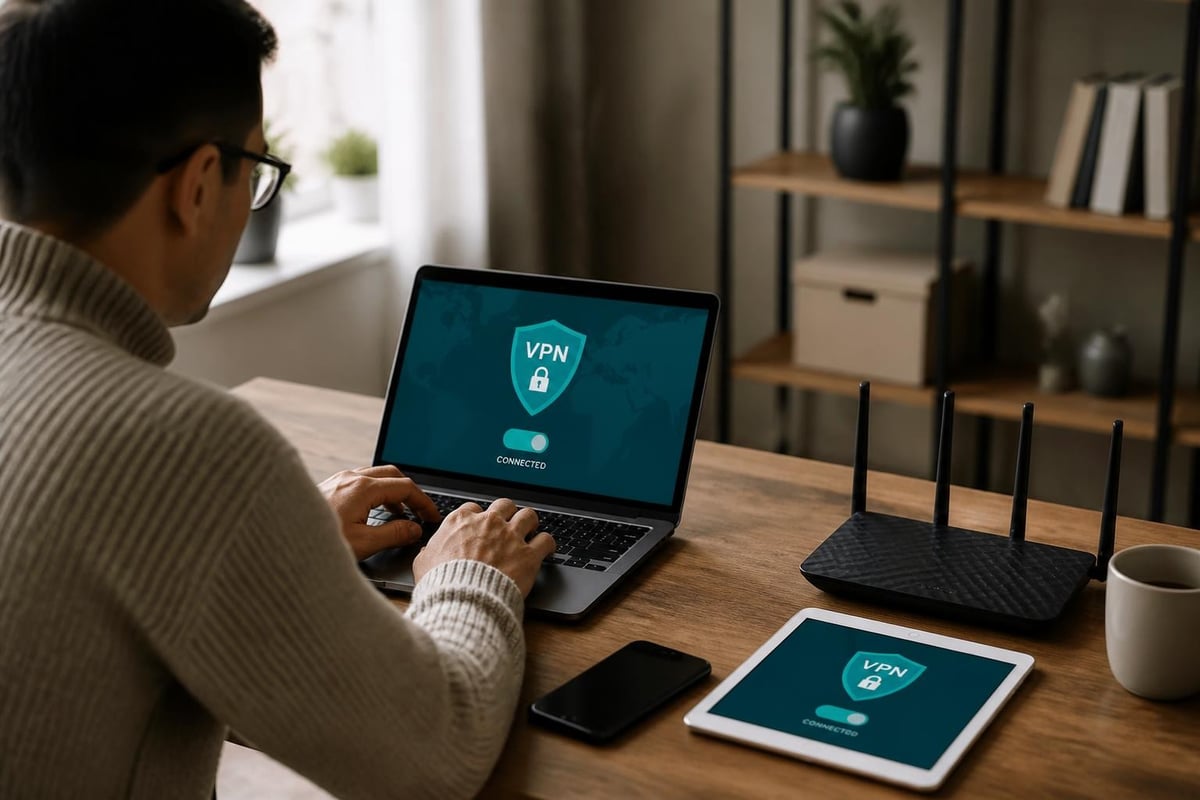
Privacy router implementations fall into two main categories. Dedicated hardware solutions arrive pre-configured with security software, offering plug-and-play simplicity that appeals to users seeking immediate protection without technical expertise. For those seeking this convenience, pre-configured VPN routers eliminate the complexity of manual setup whilst providing enterprise-grade security for home networks.
Software-based approaches involve installing privacy-focused firmware like pfSense, OpenWrt, or DD-WRT onto compatible router hardware. This method grants greater customisation and control but demands technical knowledge and ongoing maintenance.
| Approach | Setup Difficulty | Customisation | Cost | Best For |
|---|---|---|---|---|
| Pre-configured hardware | Minimal | Moderate | Higher initial | Non-technical users, immediate protection |
| Custom firmware | Advanced | Extensive | Lower hardware, higher time | Technical users, specific requirements |
| Cloud-managed privacy | Low | Limited | Subscription-based | Remote workers, multi-location |
Evaluating Privacy Router Capabilities
Not all privacy routers deliver equivalent protection levels, making careful evaluation essential before committing to a solution. Several key factors distinguish exceptional devices from merely adequate alternatives.
VPN Protocol Support
The VPN protocols supported by your privacy router directly impact both security strength and connection performance. Modern implementations favour WireGuard for its lean codebase, faster speeds, and robust cryptography. This protocol excels particularly for streaming and gaming whilst maintaining excellent security credentials.
OpenVPN remains the established standard, offering proven security through extensive real-world testing and broad compatibility. Its flexibility allows fine-tuned configurations for specific security requirements.
Some routers support multiple protocols, enabling users to select based on their current activity. Streaming might benefit from WireGuard's speed, whilst maximum anonymity scenarios could leverage OpenVPN's battle-tested encryption.
Processing Power and Performance
Encryption demands computational resources. Insufficient processing capability results in network bottlenecks that slow your internet connection to a crawl, negating the speed advantages of modern broadband. When evaluating options, privacy-focused routers designed for 2026 typically feature processors specifically selected to handle encryption overhead whilst maintaining throughput.
Key performance indicators include:
- Encryption throughput – measured in megabits per second under VPN load
- Concurrent connection handling – how many devices can connect without degradation
- RAM capacity – affects filtering database size and responsiveness
- Storage for logs and configuration – enables comprehensive monitoring

Network Segmentation Capabilities
Sophisticated privacy routers enable network segmentation, creating isolated zones for different device categories. This architectural approach contains potential security breaches and allows tailored privacy settings for each segment.
A typical implementation might establish separate networks for:
- Primary devices (computers, phones) with maximum privacy protection
- Smart home devices with restricted internet access to prevent data leakage
- Guest networks that isolate visitor devices from your private systems
- IoT quarantine zones for devices with questionable security practices
The guest network feature serves purposes beyond hosting visitors, functioning as a strategic tool for containing potentially compromised or privacy-invasive devices.
Privacy Threats Modern Routers Address
Understanding the specific threats privacy routers mitigate helps contextualise their value proposition and informs purchasing decisions.
ISP Surveillance and Data Monetisation
Internet service providers occupy a privileged position in the data collection ecosystem. They observe every website you visit, every service you access, and can construct detailed behavioural profiles from this information. Many monetise these insights through targeted advertising partnerships or direct data sales.
Privacy routers disrupt this surveillance through comprehensive encryption. When implemented correctly, your ISP observes only encrypted connections to VPN servers, not your actual browsing destinations or activities. This protection extends automatically to every device on your network, including those incapable of running VPN software directly.
Recent concerns about motion-detecting features in consumer routers highlight how equipment provided by ISPs may contain privacy-invasive capabilities, reinforcing the case for independently controlled networking hardware.
Geographic Restrictions and Censorship
Content providers and governments increasingly restrict access based on geographic location. Privacy routers enable connection through servers in different countries, effectively changing your apparent location for all connected devices simultaneously.
This capability proves valuable for:
- Accessing region-locked streaming content whilst travelling
- Bypassing workplace or institutional network restrictions
- Circumventing government censorship in restrictive jurisdictions
- Testing websites and services from different geographic perspectives
Device-Level Tracking and Fingerprinting
Modern tracking extends far beyond simple cookies. Advertisers and analytics companies employ sophisticated fingerprinting techniques that identify devices based on their unique configuration characteristics. These methods persist even after clearing cookies or using private browsing modes.
Network-level privacy measures implemented by privacy routers disrupt some fingerprinting vectors by normalising certain traffic characteristics and blocking tracking scripts before they reach your devices. Whilst not completely eliminating fingerprinting, they substantially increase the difficulty and reduce the accuracy of such techniques.
Implementation Considerations and Best Practices
Successfully deploying a privacy router requires attention to configuration details and ongoing management practices that maximise security effectiveness.
Initial Configuration Priorities
Upon first installation, several critical settings demand immediate attention:
- Change default credentials – Default administrative passwords represent glaring security vulnerabilities
- Configure VPN failsafe mechanisms – Ensure traffic cannot bypass the VPN if the connection drops
- Enable automatic updates – Security patches must deploy promptly
- Establish DNS privacy – Configure encrypted DNS providers
- Review logging policies – Balance security monitoring against privacy preferences
Many users overlook the failsafe configuration, potentially exposing unencrypted traffic during temporary VPN disconnections. Proper implementation blocks all internet access when the VPN connection fails, preventing inadvertent exposure.
Balancing Privacy With Functionality
Maximum privacy settings occasionally conflict with functionality requirements. Aggressive ad blocking might break legitimate websites, whilst stringent firewall rules could interfere with gaming or video conferencing.
Effective privacy router deployment requires finding equilibrium between protection and usability:
Banking and financial services often employ fraud detection systems that flag VPN connections as suspicious. Maintaining a separate network segment without VPN for these activities prevents inconvenient security lockouts whilst preserving privacy for general browsing.
Smart home devices frequently require cloud connectivity for full functionality. Rather than blocking this entirely, implement monitoring to ensure devices communicate only with legitimate manufacturer servers and schedule connection windows to minimise exposure.
Gaming and real-time applications may experience increased latency through VPN connections. Selecting geographically proximate VPN servers or implementing policy-based routing that sends gaming traffic through direct connections whilst protecting other activities maintains performance.
Monitoring and Maintenance Requirements
Privacy routers demand ongoing attention to maintain security effectiveness. Unlike set-and-forget consumer equipment, these devices benefit from regular review and optimisation.
| Task | Frequency | Purpose |
|---|---|---|
| Firmware updates | When released | Patch security vulnerabilities |
| Log review | Weekly | Identify suspicious activity patterns |
| VPN server rotation | Monthly | Prevent profiling by VPN provider |
| Configuration backup | Monthly | Enable rapid recovery from failures |
| Performance testing | Quarterly | Verify encryption overhead remains acceptable |
| Credential rotation | Annually | Limit exposure from potential breaches |
Advanced Privacy Router Strategies
Beyond basic implementation, several advanced techniques enhance privacy protection for users with elevated security requirements or specific threat models.
Multi-Hop VPN Configurations
Single VPN connections protect against ISP surveillance but place substantial trust in the VPN provider. Multi-hop configurations route traffic through multiple VPN servers operated by different providers, ensuring no single entity possesses complete visibility into your activities.
Implementation complexity increases substantially, as does latency, making this approach suitable primarily for high-security scenarios rather than everyday browsing. The trade-off between privacy and performance requires careful consideration based on your specific needs.
Tor Integration for Maximum Anonymity
Some privacy routers support integration with the Tor network, which provides anonymity through a distributed network of volunteer-operated relays. Getting started with Tor traditionally involves browser-based solutions, but router-level implementation extends protection to all devices automatically.
Research into privacy-preserving router implementations demonstrates the feasibility of hardware solutions that route traffic through anonymity networks like Tor, though performance limitations make this unsuitable for bandwidth-intensive activities like streaming or video conferencing.
Privacy-Preserving Technologies
Emerging technologies continue advancing privacy router capabilities. Alternative anonymity networks like I2P offer different trade-offs between performance, security, and anonymity compared to traditional VPN or Tor approaches.
Portable Tor router implementations using single-board computers demonstrate how privacy protection can extend beyond the home to travel scenarios, creating secure connectivity regardless of location.
Academic research into privacy-preserving frameworks explores advanced techniques that may eventually filter into consumer privacy products, offering enhanced protection without corresponding performance penalties.
Selecting the Right Privacy Router Solution
The optimal privacy router depends entirely on your specific requirements, technical capabilities, and threat model. No universal recommendation suits all users equally.
Assessment Framework
Begin by evaluating these key dimensions:
Technical comfort level – Can you troubleshoot network issues, modify configurations, and interpret log files? Pre-configured solutions eliminate these requirements but reduce customisation options.
Performance requirements – Do you stream 4K video, engage in competitive gaming, or work with large file transfers? Ensure your privacy router maintains adequate throughput under encryption load.
Device ecosystem – How many devices connect to your network? Do you operate smart home systems, security cameras, or other IoT devices requiring special handling?
Privacy threat model – Are you protecting against casual ISP surveillance, targeted government monitoring, or sophisticated corporate espionage? Threat severity dictates appropriate countermeasures.
Budget constraints – Quality privacy routers command premium pricing compared to basic consumer equipment, but the investment delivers ongoing protection without subscription fees for every device.
Compatibility Verification
Before committing to any privacy router solution, verify compatibility with your existing infrastructure. Selecting appropriate VPN services for routers requires confirming that your chosen VPN provider supports router implementations and offers adequate server locations for your needs.
Check whether your internet service provider imposes restrictions that might complicate privacy router deployment. Some ISPs require specific authentication methods or employ carrier-grade NAT that interferes with certain VPN protocols.
Consider future expansion requirements. Will your privacy needs grow? Does the router support firmware updates that add capabilities? Can it handle increased device counts as your smart home ecosystem expands?
Privacy routers represent a fundamental shift from device-by-device security to comprehensive network protection, ensuring every connected gadget benefits from encryption and privacy safeguards. Whether you're concerned about ISP surveillance, seeking to bypass geographic restrictions, or protecting smart home devices from data collection, a properly configured privacy router provides robust defence without requiring technical expertise on every device. U Shield VPN delivers pre-configured solutions that eliminate complexity whilst providing enterprise-grade protection powered by WireGuard and OpenVPN technologies, enabling you to secure your entire network with a single plug-and-play device designed for home users, remote workers, and businesses alike.
