





The average U.S. website now deploys 23 hidden trackers the moment you land on a page. Some major finance sites even push that number to over 400 individual monitors. You aren’t just browsing. You’re being cataloged. It’s natural to ask, “am I being tracked online” every time a creepy ad for a product you just mentioned appears in your feed. This isn’t just a browser issue anymore. It’s a network-wide surveillance ecosystem that follows you across every device in your home. You’re living in a digital shadow that grows with every click.
We understand the exhaustion that comes from complex privacy settings and the fear of identity theft. You deserve absolute peace of mind while you work and play. This 2026 guide identifies exactly how you are being monitored. It provides the streamlined steps required to reclaim your digital freedom. We’ll explore the impact of the latest state privacy laws and why true security now requires a hardware-level response. You’ll get a clear, actionable checklist to improve your security immediately. Protection should be silent and powerful. We’re here to show you the way back to a private life.
Key Takeaways
- Understand that digital surveillance is a silent, continuous process mapping your movements across every app and website.
- Stop wondering “am I being tracked online” and identify the persistent methods trackers use to follow you across the web.
- Reclaim your digital freedom to prevent dynamic pricing and regain control over your personal information.
- Take immediate action by auditing app permissions and switching to high-performance, privacy-focused browsing alternatives.
- Discover how a hardware-level response like a VPN router provides effortless, automatic protection for every device in your home.
The Reality of Digital Surveillance: Yes, You Are Being Tracked
The question “am I being tracked online” isn’t a matter of if. It’s a matter of how much. Every time you open an app or load a webpage, a silent machinery begins to work. This isn’t just about cookies anymore. Tracking is the continuous collection of your digital movements, habits, and preferences. It happens silently in the background of almost every digital interaction. This process starts the moment you connect to the internet. It creates your digital shadow. This shadow is a persistent, growing record of your life that exists outside your control.
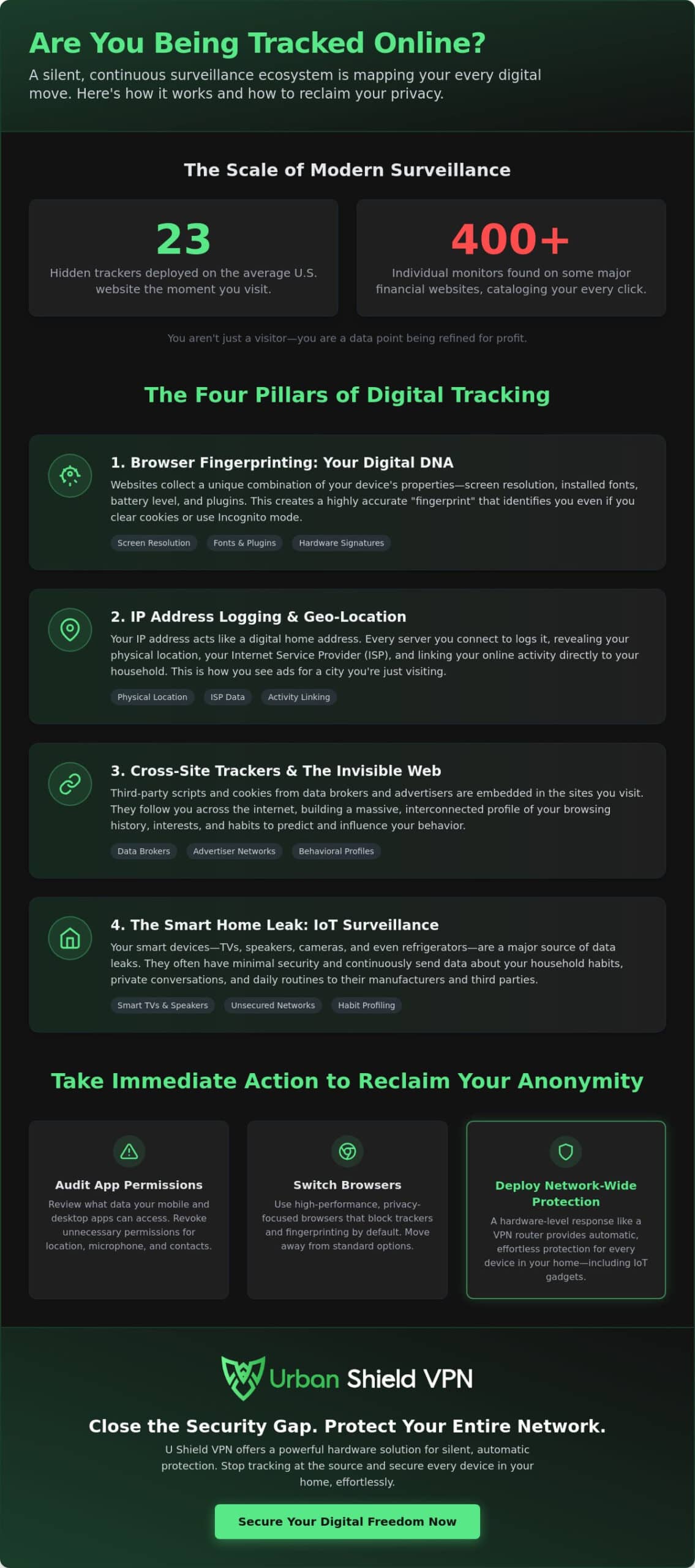
Modern Web tracking technologies are incredibly sophisticated. They don’t just look at what you buy. They monitor how you move your mouse. They record your typing speed to create a biometric profile. They know your precise location within a few meters. As of May 2026, the national average for a U.S. website is 23 trackers per page visit. Some financial sites reach over 400. You aren’t just a visitor. You are the data point being refined for profit. This surveillance ecosystem captures several key data points:
- Location: Your physical movements are mapped via IP addresses and GPS data.
- Interests: Your clicks and hover time reveal your deepest preferences to advertisers.
- Biometrics: Your typing speed and scroll patterns create a unique digital fingerprint.
The Invisible Hand: Who is Watching?
Advertisers are the most visible participants. They seek to build a profitable consumer profile to predict your next purchase. They want to know your interests before you do. However, they aren’t alone in this ecosystem. Your Internet Service Provider (ISP) logs your entire browsing history. They see every site you visit. They know when you’re home and when you’re away. Then there are data brokers. These companies buy and sell your personal information like a commodity. By mid-2026, regulations like the California Delete Act have forced these brokers to register, but their influence remains global. They operate in the dark to turn your habits into revenue.
Passive vs. Active Tracking
Understanding your vulnerability requires a look at how data is gathered. Active tracking involves information you give away willingly. This includes social media posts, email signups, and online forms. It feels like a choice, even if the consequences are hidden. Passive tracking is different. It happens without any action on your part. It captures your IP address, device ID, and unique hardware signatures. Passive tracking is the unseen collection of metadata that identifies you without your consent. It’s the foundation of modern surveillance. It works in the background while you focus on your life. It’s why you feel watched even when you haven’t clicked a single ad.
The Four Pillars of Modern Digital Tracking
Tracking has evolved into a persistent ecosystem. It’s no longer just about simple browser cookies that you can easily delete. Modern methods are designed to stay. They survive even when you clear your history or switch devices. Understanding these four pillars is your first step toward total digital freedom. Most users are currently vulnerable to all four methods simultaneously without realizing it. This continuous monitoring builds a profile that is nearly impossible to shake without the right tools.
Browser Fingerprinting: Your Digital DNA
Websites don’t need your name to know exactly who you are. They collect your screen resolution. They check your battery level. They even list your installed fonts and plugin versions. This specific combination creates a “fingerprint.” It is unique to you among billions of other internet users. Standard “Incognito” modes offer no protection against this. These modes hide your history from your family, but they don’t hide your identity from the site itself. Understanding how websites and apps track you through these technical signatures is vital for modern privacy.
IP Address Logging and Geo-Location
The Smart Home Leak: IoT Surveillance
Your computer isn’t the only window into your life. Smart TVs, speakers, and appliances are major contributors to your digital shadow. These devices often track usage habits without clear opt-outs. They rarely have built-in privacy settings. Most don’t support traditional security apps, leaving them wide open to data collection. This creates a massive security gap in the modern home. Securing these devices requires network-wide VPN protection. By moving security to the router level, you protect every device automatically. You can start building this invisible shield at ushieldvpn.com to ensure your home remains a private sanctuary.
Cross-App Data Sharing
The apps on your phone are rarely isolated islands. They constantly talk to each other through shared SDKs and tracking pixels. This allows a social media app to know what you searched for in a shopping app. It creates a seamless web of surveillance that follows you from your morning scroll to your evening purchases. This pillar relies on your device ID to bridge the gap between different services. Breaking this cycle requires strict permission management and encrypted connections that block these silent handshakes before they happen.
Why Privacy Matters: It Is More Than Just Having Nothing to Hide
Privacy is about power. It’s the ability to choose what the world knows about you. Many people dismiss surveillance because they “have nothing to hide.” This is a dangerous misconception. Privacy is about control. When your data is harvested, you lose the ability to manage your own reputation and financial future. A Princeton University study on online tracking revealed the massive scale of this data collection across the most popular websites. This isn’t just about targeted ads. It’s about how your digital shadow influences your life.
Your history is a permanent record. It stays with you long after you close the tab. This record can influence your future insurance rates or credit scores. Companies analyze your habits to determine your risk level. If your data suggests certain lifestyle patterns, you might pay more for coverage. Predictive modeling is the new standard. Lenders could use your browsing behavior to gauge your financial stability. Reclaiming your privacy isn’t just a technical preference. It is a financial necessity. When you ask “am I being tracked online,” you’re really asking if your future is being sold to the highest bidder.
Price Discrimination: The Cost of Being Tracked
Tracking directly impacts your wallet. Retailers often show higher prices based on your browsing habits. This is called dynamic pricing. If an algorithm determines you are likely to pay more, the price goes up. Travel and flight costs frequently fluctuate based on your perceived wealth profile. They look at your location and your device type. Anonymity ensures you see the same fair price as everyone else. It levels the playing field. Without a shield, you are essentially paying a tracking tax on every major purchase. Privacy keeps your money in your pocket.
The Threat of Data Breaches and Identity Theft
Companies that track you rarely secure your data perfectly. They prioritize collection over protection. This creates a massive risk for you. A single breach can link your anonymous habits to your real name and address. This makes your tracked history a goldmine for identity thieves. They use your interests and routines to craft perfect phishing attacks. Reducing your digital footprint reduces your risk of becoming a target. It’s simple logic. The less data they have, the less they can lose. You stop being a high-value target the moment you become invisible.
When you wonder “am I being tracked online,” remember that your physical safety and financial security are at stake. Identity theft isn’t just a nuisance. It’s a life-altering event. Protecting your data today prevents a crisis tomorrow. It provides the peace of mind that comes from knowing your personal life isn’t a commodity for sale. True freedom is the ability to browse without being followed.
Immediate Steps to Reclaim Your Digital Anonymity
Taking back your privacy doesn’t have to be a chore. It starts with small, deliberate changes that break the tracking cycle. You’ve identified the pillars of surveillance. Now, you must dismantle them. The first step is your browser. Stop using data-heavy browsers that prioritize advertising over your security. Switch to privacy-focused alternatives like Firefox or Brave. As of June 2026, Firefox version 152.0.1 offers robust built-in protections against the common trackers we discussed earlier. These tools block the silent collection of your habits by default.
Reset your digital identity regularly. Clear your cache and cookies at least once a week. This simple action clears the tracking IDs that websites use to follow you across sessions. It forces them to treat you as a new visitor. Next, audit your app permissions. Most mobile apps request 24/7 location access without a functional need. Go to your settings. Revoke location permissions for any app that doesn’t require it to work. This immediately stops the constant stream of geo-data being sent to brokers. You shouldn’t have to ask “am I being tracked online” when you’re just checking the weather.
Software Solutions for Your Mobile Devices
Your phone is your most vulnerable connection point. It’s often on public Wi-Fi, leaving your data exposed to local snooping. Install a VPN app for phone to encrypt your traffic instantly. This masks your IP address from every site you visit. Within your smartphone settings, find the “Limit Ad Tracking” or “Opt out of Interest-Based Ads” option. Enable it. This prevents apps from using your unique device ID to build an advertising profile. Finally, move your conversations to encrypted messaging apps. Tools like Signal ensure that your private chats remain private, away from the eyes of providers.
Hardening Your Home Network
Privacy at home requires a broader strategy. Start by changing your default DNS provider. Most people use the DNS provided by their ISP, which logs every domain you visit. Switch to a privacy-respecting provider like Cloudflare or Quad9. This adds a layer of invisibility to your browsing. Next, check your Smart TV settings. Disable “Automatic Content Recognition” (ACR). This feature monitors what you watch to sell your viewing habits to advertisers. Turn it off to keep your living room private. Recognize that software-only solutions have limits. They only protect the device they are installed on. For total peace of mind, secure your entire environment with a U Shield VPN Plan today. Protection should be effortless and all-encompassing.
Closing the Security Gap: The Power of Network-Wide Protection
Software VPNs are excellent tools for individual security. They mask your data while you are on the go. But they have a clear limit. They only protect the specific device where the app is active. Your laptop might be secure, but your digital shadow continues to leak through other cracks. Your Smart TV, gaming console, and smart appliances often lack the ability to run privacy software. These “un-appable” devices are frequently the biggest contributors to your data profile. A network-wide response is the only way to achieve total digital silence.
If you still find yourself asking “am I being tracked online” after securing your phone, look at your living room. Your Smart TV monitors your viewing habits to serve targeted ads. Your smart thermostat logs your daily routines. Even your smart light bulbs can leak metadata about your presence at home. These devices are designed for convenience, not privacy. They often lack the processing power for individual encryption apps. A VPN router closes these gaps by encrypting your entire internet connection at the source. It ensures that every byte of data leaving your home is invisible to outside eyes. It turns your entire living space into a private sanctuary without requiring you to manage dozens of different apps.
The U Shield VPN Router: Sophisticated Simplicity
Security should be invisible. We designed the U Shield VPN Router to provide sophisticated protection through a plug-and-play experience. It requires zero technical knowledge to set up. You simply connect it to your existing modem. Every device that joins your Wi-Fi is protected instantly. This includes your guests’ phones and your children’s tablets. Protection is automatic. It stays in the background, working silently to guard your family. Learn why a pre-configured VPN router is the gold standard for 2026. It removes the technical burden from your shoulders and places it on ours. It ensures your security is as modern as the threats it blocks.
Military-Grade Encryption for Total Peace of Mind
We don’t compromise on your safety. Our systems utilize military grade encryption VPN protocols to keep your data out of reach. This AES-256 standard is the same level of security used by governments to protect top-secret information. It stops advertisers, ISPs, and hackers in their tracks. They cannot see your history. They cannot map your habits. They cannot sell your life. You gain the freedom to browse, stream, and work without the weight of surveillance. Protection should be effortless. U Shield VPN makes it so. Reclaim your digital space today and experience the quiet authority of true privacy. Your home should be the one place where you aren’t a product for sale.
Your digital shadow doesn’t have to follow you forever. By moving your defense to the network level, you eliminate the vulnerabilities that individual apps miss. You stop being a target and start being a ghost in the machine. This is the ultimate step in reclaiming your digital anonymity. It provides the lasting peace of mind that comes from knowing your home is truly your own. It is the final piece of the privacy puzzle.
Reclaim Your Digital Sovereignty
Surveillance is the default state of the modern web. You now understand the pillars of tracking and the real financial cost of being monitored. Privacy isn’t a luxury. It’s a fundamental right that protects your reputation and your wallet. You don’t have to wonder “am I being tracked online” any longer. You have the knowledge to break the cycle. The transition from being a target to being invisible starts at your network’s edge. True protection should be a silent, powerful guardian.
The U Shield VPN Router offers exactly that. It features military-grade AES-256 encryption to secure every byte of data leaving your home. Our built-in anti-tracker technology stops surveillance before it ever reaches your devices. This is plug-and-play hardware designed for a zero-stress setup. No jargon. No complications. Just absolute peace of mind. Secure your entire home with the U Shield VPN Router now. Reclaim your digital freedom and enjoy the security you deserve. U Shield VPN ensures your private life is finally your own again.
Frequently Asked Questions
Is it legal for companies to track me online?
Yes, online tracking is largely legal, but the regulatory landscape is shifting. As of June 2026, 20 U.S. states have comprehensive consumer privacy laws in effect. New laws in Indiana, Kentucky, and Rhode Island became active on January 1, 2026. These regulations require companies to be more transparent about their data collection. However, they don’t stop tracking by default. You must still take active steps to protect your data.
Does Incognito mode stop websites from tracking me?
No, Incognito mode only prevents your browser from saving your history locally. It doesn’t hide your identity from the websites you visit. They can still see your IP address and use browser fingerprinting to identify you. To stay invisible, you need a tool that masks your network signature entirely. True privacy requires encryption that goes beyond simple browser settings.
How can I tell if my phone is being tracked?
You can spot signs of surveillance by monitoring your device’s behavior. Look for unexplained battery drain or sudden spikes in data usage. These often indicate background processes sending data to remote servers. If you see highly specific ads for things you’ve only discussed offline, it’s a clear signal. Stop asking “am I being tracked online” and start auditing your app permissions. Practical vigilance is your first line of defense.
Can my ISP see what I do if I use a VPN?
No, your ISP cannot see your specific browsing activity when you use a VPN. They only see an encrypted stream of data moving to a secure server. They won’t know which websites you visit or what files you download. This encryption restores your privacy by cutting the ISP out of your digital life. It turns your connection into a private tunnel that others cannot peer into.
What is the most effective way to stop all online tracking?
The most effective method is a layered defense that starts at the network level. You must combine privacy-focused browsers with hardware-level encryption. A VPN router is the ultimate solution. It acts as a silent, powerful guardian for your entire digital environment. This removes the human error of forgetting to turn on an app. It creates a permanent shield for every device you own.
Do free VPNs protect me from being tracked?
No, free VPNs often present a significant security risk. Maintaining a global server network is expensive. If you aren’t paying for the service, your data is likely the product. Many free providers log your activity and sell it to the same advertisers you are trying to avoid. True peace of mind requires a verified, professional service that prioritizes your anonymity over profit.
How does a VPN router differ from a standard VPN app?
A VPN app only protects the single device where it is installed. In contrast, a VPN router secures your entire network at the source. This includes “un-appable” devices like Smart TVs and IoT sensors that apps cannot reach. It’s a set and forget solution. It ensures you never have to worry “am I being tracked online” while you’re at home. You get effortless, total coverage for the whole family.
