

A 2026 survey revealed that 60% of U.S. adults now use a VPN to reclaim their digital boundaries. Many do this to stop AI companies from harvesting their personal data. When you search for a military grade encryption VPN, you want strength. You want invisibility. You likely feel the weight of protecting a house full of smart devices from constant threats. Technical jargon shouldn’t stand in your way. Security should be simple. It should be effortless.
We agree that peace of mind is your highest priority. You deserve a network that works silently in the background as a powerful guardian. This guide will teach you exactly what military grade encryption means for your privacy and how to secure every device on your network. We will explain the power of AES-256 security and show you how to build an impenetrable digital perimeter for your home. Protection starts here. Privacy follows.
Key Takeaways
- Understand why AES-256 is the gold standard for a military grade encryption VPN and how it shields your most sensitive data.
- Discover why 256-bit encryption is mathematically unbreakable for current supercomputers; ensuring your information stays private for generations.
- Learn why a Kill Switch is essential to prevent data leaks the moment your connection drops.
- See how a U Shield VPN Router creates a secure perimeter for every device in your home; from smart TVs to gaming consoles.
- Audit your own security with a professional checklist designed to verify your digital defense and peace of mind.
What is Military Grade Encryption in a VPN?
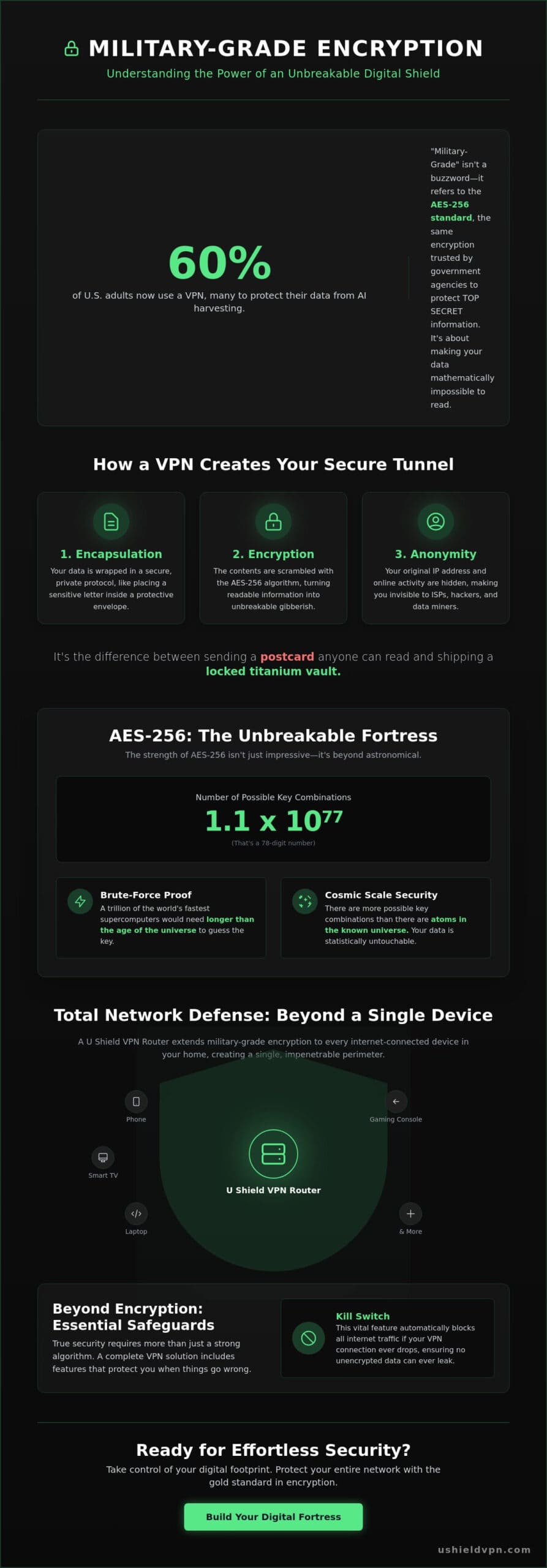
The term “military-grade” isn’t just a marketing buzzword. In the world of cybersecurity, it has a specific, technical meaning. It refers to the AES-256 standard. This is the same level of protection used by government agencies to shield Top Secret information. When you use a military grade encryption VPN, you’re essentially deploying a digital shield vetted by the world’s most demanding security experts. It’s about more than just hiding your data. It’s about making it mathematically impossible to read.
Why do we use this term? It signals a shift from basic consumer security to professional-grade defense. It means your data isn’t just obscured; it’s locked behind a wall of code. This provides a sense of absolute reliability. You can browse, stream, and work with quiet confidence. Your privacy isn’t a suggestion. It’s a technical reality. This level of security turns the complex world of digital defense into something approachable and effortless for everyone.
The Origins of the AES-256 Standard
The Advanced Encryption Standard (AES) was born from a search for speed and strength. By the late 1990s, the previous standard, DES, was becoming vulnerable to brute-force attacks. The US government needed a replacement. They held a global competition to find a new algorithm that was efficient in both hardware and software. AES was the winner. It became the gold standard for protecting sensitive information across all government branches.
Security comes in three key lengths: 128, 192, and 256 bits. While 128-bit is secure, 256-bit is the current ceiling for digital protection. It offers 1.1 x 10^77 possible combinations. This number is too large for the human mind to grasp. It ensures that even with the most powerful supercomputers available today, your data remains untouchable. This transition to AES-256 has made modern digital life possible. It allows us to communicate and transact without fear of compromise.
How a VPN Applies This Encryption
Encryption is the foundation of your online anonymity. A VPN works by creating a secure, invisible tunnel between your device and the internet. This process is called encapsulation. Your data packets are placed inside a protected “envelope.” Before they leave your device, the VPN scrambles them using the AES-256 algorithm. This is encryption in transit. It protects your information as it moves across public networks and ISP servers. It’s the difference between sending a postcard and sending a locked titanium vault.
- Encapsulation: Wrapping your data in a secure, private protocol.
- Encryption: Scrambling the contents so only your device and the VPN server can read them.
- Anonymity: Hiding your IP address and activity from prying eyes.
This differs from encryption at rest, which protects files sitting on a hard drive. A VPN focuses on the journey. It ensures that if a hacker intercepts your data, they see nothing but gibberish. This guardian works silently in the background. It removes the technical burden from your shoulders. You enjoy the internet. We handle the security. By simplifying the “how,” we empower you to take control of your digital footprint with ease.
The AES-256 Standard: Why It Is Mathematically Unbreakable
A true military grade encryption VPN relies on a mathematical fortress. While many people use the term, few explain why it actually works. The secret lies in the key length. AES-256 uses a 256-bit key to scramble your data. Every single bit added to a key doubles the number of possible combinations. Moving from 128-bit to 256-bit isn’t just a small step up; it’s a massive, exponential leap in protection. It makes the task of guessing the key impossible for any modern machine.
This level of security provides absolute peace of mind. You don’t have to wonder if your data is safe. You know it is. The standard is so reliable that it has become the default for any organization handling sensitive information. It acts as a silent, powerful guardian for your digital life. It turns complex math into a simple, effective shield that works for you every second you’re online.
The Math Behind the Security
To visualize the strength of a 256-bit key, think about the number of possible combinations. It’s 2 to the power of 256. This results in a 78-digit number that is hard to wrap your head around. It’s more than the number of atoms in the known universe. According to the NIST FIPS 197 standard, this algorithm is designed to resist all known brute-force attacks. Even a trillion computers would take longer than the age of the universe to crack it. This isn’t just a high bar; it’s a physical limit that can’t be bypassed by current technology.
Quantum computing is often mentioned as a theoretical threat. These future machines might process calculations much faster than today’s hardware. However, AES-256 was built with the future in mind. Even with quantum advancements, a 256-bit key remains secure because the sheer number of combinations is too vast. It effectively future-proofs your network. You get a solution that’s ready for tomorrow’s challenges today.
Encryption Performance and Speed
You might worry that such heavy security would slow you down. In the past, high-level encryption required significant processing power. That’s no longer the case. Modern CPUs are designed with specific instructions to handle AES encryption instantly. This means your military grade encryption VPN can operate at peak speeds without causing lag or overheating your devices. It’s a streamlined process that prioritizes both velocity and invisibility.
The choice of protocol also impacts your experience. Modern options like WireGuard or optimized versions of OpenVPN ensure that data packets move quickly through the encrypted tunnel. This allows you to stream high-definition content or play games without interruption. When you use a high-performance VPN solution, you’re choosing a system where hardware and software work in perfect harmony. You get the ultimate defense without the technical burden. It’s security that’s fast, modern, and deeply respectful of your time.
Beyond the Buzzword: Essential Features for True Privacy
Encryption is your digital fortress. However, even the strongest walls need a gate that stays shut. A military grade encryption VPN provides the foundation for your security, but it’s only one part of a complete defense system. If your VPN connection drops for even a second, your device might revert to its standard, unencrypted path. This creates a momentary leak where your true IP address and activities are exposed to your ISP or hackers. True privacy requires a holistic approach that manages the connection as strictly as the data itself.
Reliability is the hallmark of a professional-grade service. You need a system that acts as a silent, powerful guardian. This means ensuring that your data is never stored and your identity is never leaked. A strict No-Logs policy is the second pillar of this defense. Without it, the strongest AES-256 encryption only protects your data while it’s moving. Once it reaches the VPN server, a provider without a No-Logs policy could theoretically store or sell your history. We believe your information belongs to you alone.
The VPN Kill Switch: Your Emergency Brake
A Kill Switch is a non-negotiable safety feature. It acts as an automated sentry. If your VPN connection fluctuates, the Kill Switch instantly cuts your internet access. This prevents unencrypted data from leaving your device. It’s an essential tool for anyone using public Wi-Fi in cafes or airports. In these environments, connections are often unstable. Without an emergency brake, your sensitive login details could slip through a gap in the shield. Understanding what is a VPN kill switch and how it functions ensures your perimeter remains intact at all times.
- Instant Reaction: Blocks all traffic the millisecond a connection fails.
- Automatic Recovery: Restores access only when the secure tunnel is active.
- Peace of Mind: Eliminates the need to constantly monitor your connection status.
Anti-Trackers and Stealth Browsing
Hiding your IP address is only half the battle. Advertisers use invisible harvesters called trackers to follow you across the web. These scripts can build a profile of your habits even when you use a military grade encryption VPN. High-tier security solutions integrate anti-trackers to block these scripts at the source. This creates a synergy between encryption and stealth. It stops data collection before it starts. You gain a cleaner, faster browsing experience while removing the digital breadcrumbs that lead back to your identity. To understand exactly how this works and why it matters in 2026, our guide on using a VPN with anti-tracker for invisible browsing explains how to close the privacy gap for good.
This level of protection is especially vital for smart homes. Vulnerable devices like cameras or thermostats often lack their own defense mechanisms. You can learn more about securing the silent vulnerabilities on your network to ensure every device is covered. By combining encryption with active leak protection and anti-tracking tools, you build a digital environment that is truly private. It is a modern solution that takes the technical burden off your shoulders, allowing you to enjoy the internet with absolute freedom.
Evaluating Your Digital Perimeter: A Security Checklist
Securing your home network shouldn’t feel like a chore. It should feel like a relief. To ensure your protection is absolute, you need a clear way to measure your defense. A military grade encryption VPN is the standard, but you must verify how it’s implemented. Don’t settle for vague promises. Look for specific technical benchmarks that guarantee your data remains invisible to prying eyes.
We’ve simplified the evaluation process into a streamlined checklist. Use these points to audit your current setup or vet a new provider. Absolute privacy is a choice you make by choosing the right tools. It’s about building a silent, powerful guardian for your digital life.
- Encryption Baseline: Confirm the use of AES-256. It’s the non-negotiable foundation of modern security.
- Leak Prevention: Verify a functional Kill Switch and DNS leak protection. These prevent your identity from slipping through connection gaps.
- Independent Audits: Trusted providers invite third-party experts to inspect their code. This transparency builds reliability.
- RAM-Only Servers: Ensure the network uses diskless servers. These wipe all data every time they reboot, leaving no digital footprint.
- Hardware Integration: Check if the service supports router-level protection. This allows you to shield devices that can’t run apps.
Technical Requirements for 2026
Modern threats require modern solutions. By 2026, standard encryption is just the beginning. Look for Multi-hop or Double VPN features. These route your data through two separate servers, adding an extra layer of invisibility. DNS and IPv6 leak protection are also vital. They prevent your browser from accidentally revealing your location through background requests. These features turn your military grade encryption VPN into a comprehensive security suite that operates with velocity and strength.
The shift toward diskless RAM-only servers is equally important. Traditional servers store data on hard drives, which can be seized or compromised. RAM-only servers exist only in volatile memory. When the power goes out, the data vanishes. It’s a clean, efficient way to ensure total data wiping without manual intervention. It removes the risk of physical data theft entirely.
The Vulnerability of Smart Home Devices
Your Smart TV and IoT devices are often the weakest links in your perimeter. They’re designed for convenience, not defense. Most of these gadgets lack the processing power to run individual security apps. This leaves them vulnerable to hackers who can use a compromised lightbulb to access your entire network. You can learn how to prevent smart home hacking by adopting a network-wide approach.
Installing software on non-standard hardware is difficult and often impossible. This is why hardware-based protection is a superior strategy. It takes the technical burden off your shoulders. You can secure every device instantly with a U Shield VPN Router, ensuring that your fridge, camera, and console are all protected by the same high-level shield. It’s a modern solution for a modern home. Protection should be effortless. Privacy should be a constant.
Total Network Defense with U Shield VPN
True security shouldn’t be a part-time job. It should be a permanent state. While software apps provide a solid start, they often leave gaps in your home network. A military grade encryption VPN is most effective when it covers every entry point simultaneously. This is the philosophy behind the U Shield ecosystem. We provide the tools to build a comprehensive digital perimeter that works without constant management. It’s about total defense. It’s about absolute freedom. You deserve a network that is as resilient as it is invisible.
We believe in removing the technical burden from your shoulders. Our solutions are designed to be powerful yet approachable. You don’t need to be a networking expert to achieve professional-grade privacy. By integrating high-level security directly into your hardware and mobile devices, we ensure your data remains your own. This is the modern standard for digital protection. It is security that moves at the speed of your life.
The U Shield VPN Router Advantage
The U Shield VPN Router is our flagship solution for the modern home. It offers a zero-configuration setup. You simply plug it in. Protection starts immediately. This hardware-first approach bypasses the device limits found in traditional software plans. Instead of securing only a few devices, you secure the entire network at the source. This includes your Smart TV, gaming consoles, and every IoT gadget in your house. These are the devices that often lack their own defense mechanisms.
- Instant Setup: No complex menus or manual configurations required.
- Unlimited Coverage: Every device connected to the Wi-Fi is automatically encrypted.
- High-Speed Performance: Optimized to handle 4K streaming and low-latency gaming without throttling.
By securing the network at the router level, you eliminate the weakest links in your perimeter. Your data is scrambled using the same AES-256 standard we’ve discussed, ensuring that every packet leaving your home is untouchable. It’s a silent, powerful guardian that operates in the background. You get the strength of a military grade encryption VPN without the need to install apps on every single household item.
Flexible Protection for Every Lifestyle
Your protection shouldn’t stop at your front door. The U Shield VPN App brings that same level of security to your mobile life. It’s available for both Android and iPhone. It ensures your data remains invisible even on risky public Wi-Fi networks in cafes or airports. A single login provides total digital freedom across all your devices. This creates a seamless experience as you move from your home network to the outside world. Your privacy remains constant. If you’re weighing the right setup for your lifestyle, our guide on VPN app vs VPN router security for 2026 can help you decide which option best fits your needs.
We offer flexible options to fit your needs. You can choose our Monthly VPN Plan for short-term flexibility or our Annual VPN Plan for long-term peace of mind. Both options provide full access to our high-speed server network and advanced security features. Investing in your privacy is a decision that pays off in clarity and confidence. It’s time to take control of your digital footprint. Secure your home with the U Shield VPN Router today and experience the ease of absolute protection.
Secure Your Digital Perimeter Today
True privacy is no longer a luxury. It’s a necessity. We’ve explored how AES-256 encryption provides a mathematical fortress that supercomputers cannot crack. You now understand that a complete shield requires more than just code. It needs a functional Kill Switch and active Anti-Trackers to stop invisible data harvesting. Choosing a military grade encryption VPN is the most effective way to reclaim your boundaries and protect your family.
We believe security should be approachable. It should work silently in the background. Our pre-configured VPN Router delivers instant home security with AES-256 bit encryption as standard. It includes a built-in Kill Switch and Anti-Tracker to ensure your perimeter remains intact. You can get military-grade protection for your entire home with U Shield VPN right now. Take the technical burden off your shoulders. Enjoy the internet with absolute peace of mind. Your journey to a safer digital life starts here.
Frequently Asked Questions
Is military-grade encryption actually used by the military?
Yes, the U.S. government and military use AES-256 to protect classified information. It is the official standard for securing Top Secret data. This provides a level of reliability that makes complex security feel approachable for your home. You get the same shield used by professional intelligence agencies for your personal privacy.
Can AES-256 encryption be cracked by hackers?
No hacker can crack AES-256 with existing technology. It would take billions of years for the world’s most powerful supercomputers to guess the key. This mathematical certainty is why it’s the gold standard for any military grade encryption VPN. Your digital perimeter remains untouched by brute-force attacks.
Does a VPN with military-grade encryption slow down my internet?
Modern hardware handles AES encryption with negligible impact on your speed. Most CPUs now include specific instructions to process these calculations instantly. You enjoy high-level protection without sacrificing the velocity of your streaming or gaming experience. Security should be effortless and fast.
What is the difference between 128-bit and 256-bit encryption?
The difference is exponential strength. A 256-bit key has 2 to the power of 128 times more combinations than a 128-bit key. While 128-bit is secure, 256-bit is the current ceiling for digital safety. It future-proofs your connection against advancing computing power and future threats.
Do I need a VPN router if I already have a VPN app?
A VPN router provides network-wide coverage that an app alone cannot match. It secures devices like Smart TVs and gaming consoles that don’t support software installs. This creates a silent, powerful guardian for every device in your home simultaneously. It simplifies your defense by protecting the source. For a detailed breakdown of both options, see our comparison of VPN app vs VPN router to choose the best security for 2026.
Is military-grade encryption legal to use in my country?
VPN usage is legal in most countries for legitimate privacy and security purposes. However, some regions have specific regulations or data logging mandates that affect how providers operate. You should check local laws if you are traveling to countries with known internet restrictions. Protection should always follow local guidelines.
What happens if my VPN connection drops?
Your data could leak to your ISP or hackers unless you have a Kill Switch active. This feature acts as an emergency brake to block all traffic the moment the secure tunnel fails. A quality military grade encryption VPN ensures your identity never slips through these connection gaps. Reliability is our highest priority.
How do I know if my VPN is actually using AES-256?
You can verify your encryption level in the settings menu of your VPN software. Trusted providers are transparent about their protocols and standards. Look for “AES-256” or “ChaCha20” in the connection details to confirm your shield is active. This transparency builds the confidence you need for total peace of mind.
