


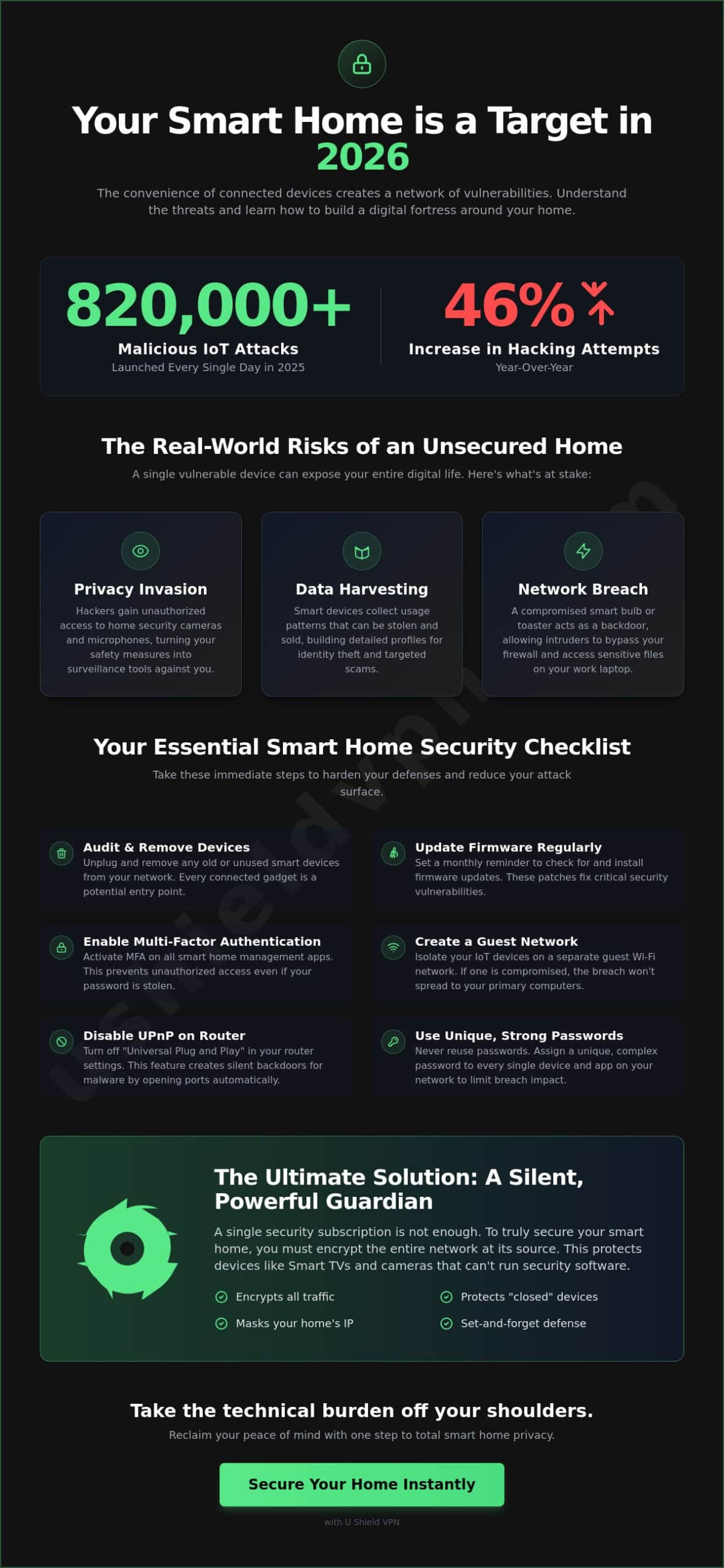
Did you know that hackers launched over 820,000 malicious IoT attacks every single day in 2025? With these attempts up 46 percent from the previous year, the need to prevent smart home hacking has never been more urgent. You likely feel the “whack-a-mole” exhaustion of updating dozens of different apps just to keep your family safe. It’s frustrating when technical jargon makes basic privacy feel like an impossible task. You shouldn’t have to be a networking expert to feel secure in your own living room.
You deserve a home where security is a silent, powerful guardian. This 2026 guide teaches you how to secure every device in your house instantly. You’ll learn how to achieve a “set and forget” defense that protects your cameras and even improves your streaming speeds. We’ll explore the latest U.S. Cyber Trust Mark standards and the most efficient ways to lock down your network at the source. It’s time to take the technical burden off your shoulders and reclaim your peace of mind. Protection should be instantaneous, not a chore.
Key Takeaways
- Close hidden entry points by auditing your connected devices and removing inactive hardware from your network.
- Strengthen your defense and prevent smart home hacking by enabling multi-factor authentication on every management app you use.
- Protect “closed” devices like Smart TVs and sensors that can’t run standard security software by encrypting data at the source.
- Shield your family’s privacy from data harvesters by masking your home’s IP address across every single connected device.
- Deploy a silent, powerful guardian that operates in the background to remove the technical burden of digital security.
Why Your Smart Home is a Target in 2026
Your home is no longer just a physical space. It’s a complex digital ecosystem. In 2025, malicious IoT hacking attempts averaged over 820,000 per day. Early 2026 data shows this trend accelerating as more households integrate connected technology. To prevent smart home hacking, you must first understand why your network is under constant surveillance. Hackers don’t just want your computer; they want every device with an IP address. Every connected gadget is a potential doorway for an intruder. If a device can talk to the internet, it can listen to a hacker.
The “weakest link” is rarely your laptop or smartphone. It’s usually the device you never think about. When we consider what is a smart home today, we see a web of convenience that doubles as a map of vulnerabilities. A smart toaster or a connected light bulb might seem harmless. However, these devices often lack the processing power to run sophisticated security. They are simple, quiet, and often entirely unprotected. This makes them the perfect entry point for lateral movement within your private network.
The IoT Security Gap
Manufacturers prioritize speed and convenience over military-grade encryption. They want your new device to work instantly. This often means security is an afterthought. Legacy devices are particularly dangerous. Many older smart home products rarely receive critical firmware updates. This leaves them open to known vulnerabilities that hackers exploit with automated tools. Your standard home router provides minimal protection against these targeted attacks. It’s a basic gatekeeper facing an army of AI-powered reconnaissance tools. Without a dedicated shield, your network remains transparent to those who know where to look.
Real-World Risks of Unsecured IoT
The consequences of a breach are deeply personal. Unauthorized access to home security camera feeds is a primary concern for modern families. Hackers can turn your own safety measures against you. Beyond visual privacy, data harvesting is a silent threat. Voice assistants and smart appliances continuously collect usage patterns. This data is often sold to third parties or stolen to build detailed profiles for identity theft. Prevent smart home hacking to stop network lateral movement. A hacker can use a vulnerable smart bulb to bypass your firewall and access your work laptop. They don’t need your password if they can enter through the fridge. Your privacy depends on securing the entire network at once.
Essential Smart Home Security Tips for 2026
Start by auditing your digital inventory. Every device you no longer use is a liability. If that first-generation smart plug is gathering dust in a corner, unplug it. Reducing your attack surface is the fastest way to prevent smart home hacking. Intruders look for neglected hardware with outdated software to gain a foothold. Once you’ve cleared the clutter, focus on your management apps. Enable multi-factor authentication (MFA) on every account. This simple step ensures that even if a hacker steals your password, they can’t access your home’s controls without a secondary code from your physical phone.
Your router settings require immediate attention. Disable “Universal Plug and Play” (UPnP) right now. While UPnP makes connecting new devices easy, it also allows them to open ports without your permission. This creates a silent backdoor for malicious actors. Instead, set up a dedicated guest network specifically for your IoT devices. Keep your smart bulbs and cameras on this isolated lane. If a single device is compromised, the hacker remains trapped in the guest network, unable to reach your primary computers or sensitive personal data.
The Manual Security Checklist
Security is a monthly habit. Set a recurring reminder to update the firmware on every connected hub. These patches often contain critical fixes for newly discovered exploits. Review the official smart home security tips to stay aligned with current federal safety standards. Beyond updates, use unique and complex passwords for every device. Avoid using the same credentials for your fridge and your email. Finally, check your app permissions. Many smart home apps request access to your location or contacts when they don’t actually need them to function. Deny any request that feels excessive.
Advanced Network Hardening
Modern protection requires modern standards. Implement WPA3 encryption on your primary Wi-Fi network to provide superior defense against password-guessing attacks. You should also disable remote management features in your router’s settings. Unless you specifically need to change network configurations while away from home, keep those controls local. For a more comprehensive approach, consult our smart home network security checklist to ensure no vulnerability goes unnoticed. If this manual maintenance feels overwhelming, a dedicated U Shield VPN Router can automate much of this heavy lifting, acting as a silent guardian for your entire household.
Why a VPN for Smart Home Devices is the Ultimate Solution
Stop playing defense with individual apps and manual updates. A VPN is the ultimate shield for your entire digital footprint. It encrypts every byte of data leaving your home. This process creates a secure, private tunnel that keeps your activities invisible to outsiders. By masking your home’s IP address, you stop trackers and hackers from pinpointing your physical location. This level of invisibility is essential to prevent smart home hacking in an era of automated reconnaissance. It also prevents your ISP from monitoring your daily habits or selling your data to advertisers.
Traditional security software often ignores the most vulnerable parts of your network. Your smart fridge, thermostat, and security cameras are frequently left exposed. These devices lack the processing power to defend themselves. A network-wide VPN fills this gap by securing the connection at the source. It ensures that every piece of data, no matter how small, is wrapped in military grade encryption VPN technology before it ever reaches the open internet. You gain peace of mind knowing your home is a fortress, not a target.
Encryption Beyond the Computer
Most smart devices aren’t built to host security software. Your smart TV or connected sensors cannot run a standalone app. This is where smart home hub vulnerabilities become a serious risk for the average family. A VPN provides military-grade encryption for these “closed” systems from the moment they connect. It stops man-in-the-middle attacks where hackers intercept data between your device and the cloud. You create a private tunnel for all outgoing traffic. Your private life stays private, exactly as it should be.
The VPN Router Advantage
Managing twenty different security apps is a recipe for failure. It’s exhausting and prone to human error. A hardware-based solution like the U Shield VPN Router changes the game entirely. It provides centralized security management for your entire household. You won’t need to install software on every individual light bulb or smart plug. Every new device that joins your Wi-Fi receives automatic protection. This “set and forget” approach is the most efficient way to prevent smart home hacking today. It takes the technical burden off your shoulders. You get to enjoy your technology while a silent, powerful guardian handles the defense in the background.
How to Secure Smart TVs and IoT Without Installing Apps
Most devices in a modern household are “closed systems.” They don’t have an app store or a user interface. You cannot install a security app on a smart light bulb or a connected thermostat. Yet, these are the exact entry points hackers exploit. In 2025, routers and IoT hubs accounted for over 75 percent of observed cyberattacks according to DeXpose. If you want to prevent smart home hacking, you have to look beyond your smartphone. You need a solution that protects the devices that cannot protect themselves.
Smart TVs are particularly aggressive data harvesters. By 2026, a typical smart home is expected to generate gigabytes of data daily. Much of this is viewing habits and personal preferences collected by TV manufacturers for third-party advertisers. Because you can’t install a VPN directly on most television operating systems, your data remains an open book. The only effective way to stop this is at the router level. You must encrypt the data before it leaves your house. This turns a vulnerable “closed” device into a secure part of your private network. If you’re looking for step-by-step methods to address this specific challenge, our guide on how to put VPN on smart TV without app covers three proven approaches including SmartDNS, connection sharing, and router-level protection. A router-level solution also unlocks the added benefit of using a VPN for streaming on your smart TV, bypassing ISP throttling and geo-blocks to enjoy buffer-free 4K playback on every screen.
Securing the “Un-appable” Devices
Start by identifying the gadgets that lack standalone security support. These are your “un-appable” devices. Once you route their traffic through a secure VPN gateway, you block trackers at the source. This prevents them from ever reaching your hardware. You’re creating a private tunnel for all outgoing IoT traffic. This approach stops man-in-the-middle attacks and keeps your usage patterns invisible to outsiders. It’s a silent, powerful guardian that covers everything from your fridge to your doorbell.
Plug and Play Protection
Manual router configuration is a major hurdle. It’s often filled with technical jargon that makes security feel impossible. This complexity leads many to leave their networks wide open. A pre-configured VPN router eliminates this stress. It’s designed to be a “plug and play” solution for total home privacy. You can secure every device in your home in under five minutes. There’s no need for manual configurations or complex app setups. It’s a sophisticated way to simplify your digital life. Take control of your network today with a U Shield VPN Router for instant, network-wide security.
U Shield VPN: One Step to Total Smart Home Privacy
You’ve identified the risks. You’ve seen the vulnerabilities of your smart TV, doorbell, and thermostat. Now, you need a solution that works as hard as you do. The U Shield VPN Router is that solution. It acts as a silent, powerful guardian for your entire household. This isn’t just another layer of software. It’s a complete hardware defense. By securing the connection at the router level, you prevent smart home hacking across every square inch of your property. No device is left behind. No digital door is left unlocked.
Most security setups feel like a second job. They require constant attention and deep technical knowledge. We’ve removed that burden from your shoulders. Our hardware is designed for absolute simplicity. It handles the complexities of encryption and tunneling in the background. You don’t need to be a networking expert to have a private home. You just need the right tools. High-speed global servers ensure your security never slows you down. Streaming 8K video on your Smart TV remains seamless. Gaming stays lag-free. You get the protection you need without sacrificing the velocity your lifestyle demands. For a deeper look at how dedicated hardware transforms your network’s defenses, our VPN router for smart home definitive 2026 security guide walks you through every step of the process.
Effortless Security for Modern Living
No jargon. No complex setups. Just total peace of mind. U Shield offers a streamlined experience through our intuitive interface. Military-grade encryption operates invisibly, protecting your family’s data 24/7. This is a solution built specifically for the 2026 smart home landscape. It understands that your time is valuable. Protection should be instantaneous. It should be a standard feature of your home, not a constant chore. Whether you’re using our hardware or the U Shield VPN App, your privacy remains our priority.
Your Next Step Toward Freedom
Stop worrying about individual device vulnerabilities. You no longer have to audit every single app or check every firmware update manually. Take control of your digital footprint today. A single subscription to our Annual VPN Plan or Monthly VPN Plan covers your entire network. This includes your phones, laptops, and every IoT device mentioned in this guide. Join the thousands of secure homes already protected by U Shield. Reclaim your privacy. Secure your future. Choose a U Shield VPN Router to prevent smart home hacking and experience the freedom of a truly protected home.
Take Control of Your Digital Sanctuary
Securing a modern home shouldn’t be a full-time job. You’ve learned that network-wide protection is the only way to effectively prevent smart home hacking across all your devices. By shifting your focus from individual apps to a centralized shield, you eliminate the technical burden and the stress of manual configurations. This approach ensures that even “un-appable” gadgets like smart bulbs and older TVs remain protected. Military-grade encryption keeps your family’s privacy invisible to trackers while maintaining the high-speed performance your 2026 lifestyle requires. It’s about working smarter, not harder.
It’s time to trade complexity for absolute confidence. Our plug-and-play hardware and 24/7 global server access provide a silent guardian that operates in the background of your daily life. You deserve a better digital experience where safety is instantaneous rather than a chore. Secure your entire smart home with a U Shield VPN Router and experience the freedom of total, effortless privacy. Your home is your sanctuary. We are here to keep it that way.
Frequently Asked Questions
Can smart home devices be hacked?
Yes. Any device with an internet connection is a potential target for intruders. Hackers use automated tools to scan for open ports or weak credentials in seconds. Once they find a gap, they can access your private data or use your hardware for larger attacks. Securing your network at the source stops these intrusions before they reach your sensitive hardware.
Does a VPN protect my smart home devices?
A VPN creates a secure, encrypted tunnel for every byte of data leaving your house. It masks your home’s IP address and hides your hardware from external trackers. This ensures your private life stays private. By wrapping your traffic in military grade encryption VPN protection, a VPN makes your data unreadable to anyone outside your network. It’s a silent, powerful guardian for your digital footprint.
How do I know if my smart home has been hacked?
Watch for unusual behavior in your gadgets. Devices might reboot randomly, move on their own, or respond slowly to commands. Slower network speeds or unexplained spikes in data usage are also common red flags. You should regularly check your router’s connected device list for any hardware you don’t recognize. If you see an unknown IP address, your security may be compromised.
Do I need a special router for a smart home VPN?
Yes. Most standard ISP routers lack the software and processing power to run network-wide VPN encryption. You need specialized hardware like the U Shield VPN Router to protect your entire household. This device handles the heavy lifting of encryption for every connected gadget automatically. It removes the technical burden from your shoulders and provides a centralized defense for your home.
Will a VPN slow down my smart TV streaming?
Not with high-performance hardware. While encryption requires processing power, our global servers are optimized for maximum speed and reliability. You can enjoy 8K streaming on your smart TV without lag or buffering issues. Security should never compromise your entertainment. High-speed servers ensure that your connection remains fast, stable, and completely invisible to outside observers.
Is it hard to set up a VPN for my whole house?
No. We’ve designed our solutions to be approachable for the average person. A pre-configured router is a plug-and-play solution that eliminates the need for complex manual setups. You can achieve total home privacy in under five minutes. There’s no jargon to learn and no stress over technical configurations. It’s a sophisticated way to simplify your digital security instantly.
Can hackers see me through my smart camera?
Unsecured cameras are a primary target for privacy breaches. Hackers can intercept unencrypted video streams or hijack weak login credentials to gain access to your home feeds. Encryption prevents this by securing the data path between your camera and the cloud. When your network is protected at the source, your camera feeds remain visible only to you and your family.
What is the easiest way to prevent smart home hacking?
The easiest way to prevent smart home hacking is to secure your network at the router level. Protecting the source ensures that every device, from your fridge to your phone, is covered by a single shield. A VPN router for smart home protection provides a silent, powerful guardian that works in the background. It’s a “set and forget” solution that offers total peace of mind without the hassle of manual updates.
