



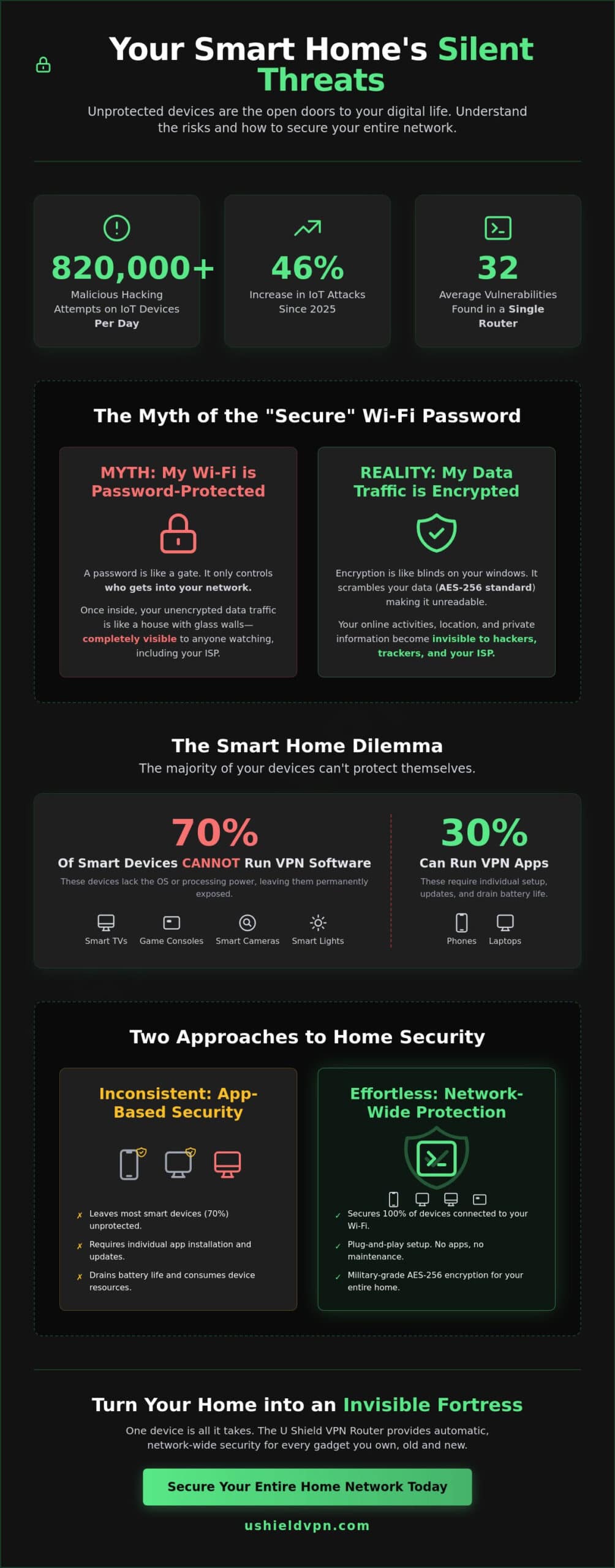
Did you know that in 2025, malicious hacking attempts on IoT devices soared to over 820,000 per day? This is a 46% increase that puts your digital life at risk every time you connect. Most of these attacks target your router, which averages 32 distinct vulnerabilities. You likely feel the weight of this reality every time you add a new smart bulb or camera. It’s exhausting to manage 20 different security settings, and the fear of invisible threats hiding in your gadgets is real. Having unprotected devices on home network setups is a gamble you can no longer afford to take.
You deserve a home that’s a sanctuary, not a target. Securing every individual device is a losing battle; the only way to win is by securing the network gateway itself. This guide shows you how to identify every silent vulnerability and shield them all with effortless, network-wide security. We’ll explore how to achieve total network invisibility and automatic protection without the constant maintenance. It’s time to reclaim your peace of mind with a solution that stays in the background while you stay safe. Discover how to turn your home into an invisible fortress today.
Key Takeaways
- Bridge the gap between “secured Wi-Fi” and “secured data traffic.” Identify unprotected devices on home network setups that transmit data without encryption.
- Learn why 70% of smart home devices cannot run traditional VPN software. Spot the silent links like smart TVs that leave your network exposed.
- Move from individual app management to a “Single Point of Protection.” Save battery life and eliminate updates by securing your gateway.
- Use a streamlined audit process to list every connected device. Evaluate which gadgets are vulnerable to invisible threats today.
- Discover the power of a plug-and-play VPN router. Gain military-grade encryption for every device without installing a single app.
What Are Unprotected Devices on a Home Network?
An unprotected device is any piece of hardware that transmits your personal data without encryption or a masked IP address. It’s a common misconception. Most people believe a Wi-Fi password equals total safety. It doesn’t. A password merely controls who enters the network; it does nothing to hide what those people do once they’re inside. In 2026, unprotected devices on home network setups are the primary targets for sophisticated data harvesting.
Think of your router as a gated community. The gate requires a code, which keeps strangers out. Just as MyGatePass streamlines access control for modern facilities, your digital gateway needs similar precision to keep data private. However, if your house has glass walls, everyone outside can still see exactly what you’re doing. Secured Wi-Fi is the gate. Secured data traffic is the set of blinds on your windows. Without encryption, your smart TV, gaming console, and even your thermostat are broadcasting your habits to anyone positioned to listen. As of early 2026, the adoption of the WPA3 security standard remains low, with only 10% of Wi-Fi authentications using it. This means most homes still rely on older, more vulnerable protocols.
The reality of 2026 is stark. Every “smart” feature added for convenience is a potential entry point for intruders. Statistics from mid-2025 show that routers are the most targeted devices, accounting for over 75% of IoT cyberattacks. The average router contains 32 vulnerabilities. When you leave these gaps open, you invite data harvesters to map your life. True protection requires moving beyond simple passwords to active, real-time encryption for every packet of data, much like how specialized industries depend on Strong Machinery Srl for the specific parts and machinery required to keep critical systems running securely. It’s about making your traffic unreadable to everyone but you.
The Invisibility of Modern Digital Threats
Digital threats aren’t always loud or obvious. They are silent. Data interception occurs when hackers “listen” to the traffic moving between your device and the internet. This isn’t just about credit card numbers. It’s about your location, your schedule, and your private conversations. Even if a hacker isn’t nearby, your Internet Service Provider (ISP) is always watching. They track your browsing habits and log your activity. In 2026, the idea of a “safe” home network is a myth unless you take proactive steps to hide your digital footprint. In 2025 alone, malicious IoT hacking attempts reached over 820,000 per day.
Defining Military-Grade Encryption
Total security relies on AES-256 encryption. This is the gold standard for home data protection, utilized by governments and financial institutions worldwide. It works by scrambling your readable information into complex, useless gibberish. Even if an intruder intercepts the data, they cannot decode it without a specific key. This process happens instantly, ensuring your speed remains high while your privacy stays intact. When combined with IP masking, which hides your physical location, your unprotected devices on home network environments are transformed into a private, invisible fortress.
The Smart Home Dilemma: Auditing Your Weakest Links
Securing your home starts with a clear-eyed audit. Most households now balance dozens of connected gadgets, yet many of these remain invisible to standard security measures. You likely have unprotected devices on home network setups right now without realizing it. The challenge is structural. Approximately 70% of home devices, from gaming consoles to smart fridges, lack the processing power or operating system to run traditional VPN software. They are designed for convenience, not defense.
Legacy hardware adds another layer of risk. Older laptops and tablets that no longer receive security patches are open doors for intruders. In 2026, these “end-of-life” devices are prime targets. Similarly, budget IoT gadgets often prioritize low costs over robust code, frequently shipping with hardcoded backdoors or default passwords that users cannot change. When you connect a cheap smart plug, you might be inviting a silent listener into your private space. These vulnerabilities contributed to the 46% increase in IoT attacks seen throughout 2025.
A single weak link compromises everything. If a hacker gains access to a vulnerable light bulb, they can move laterally across your network to reach your personal phone or work computer. This is why individual device management is no longer enough. You need a strategy that covers every “silent” vulnerability automatically. Exploring the U Shield VPN Router is a practical way to provide this blanket protection to every device you own, regardless of its age or brand.
Smart TVs and Streaming Devices
Your Smart TV is an advertising goldmine. These devices often track your viewing habits, app usage, and even your physical location to sell data to third-party brokers. Securing them is notoriously difficult. Streaming sticks and televisions rarely support native VPN apps, leaving your data traffic exposed to your ISP and advertisers. Without network-level encryption, your entertainment habits are an open book. A centralized security approach closes this gap, masking your TV’s identity without requiring complex manual setups on the device itself.
IoT: The Unseen Gateway
Smart fridges, thermostats, and light bulbs form what experts call the “Internet of Vulnerabilities.” These devices stay connected 24/7, often with minimal security oversight. Because they are always on, they provide a persistent entry point for malicious activity. In 2026, the riskiest IoT assets include VoIP systems and network video recorders. These devices require a silent guardian at the router level. By securing the point where the internet enters your home, you ensure that even the simplest light bulb operates behind a wall of military-grade encryption.
App-Based Security vs. Network-Wide Protection
Managing digital security shouldn’t feel like a part-time job. For years, the standard approach involved installing individual apps on every phone and laptop. This method is failing in 2026. It relies on constant manual intervention. You have to manage logins, stay on top of updates, and deal with noticeable battery drain. When you forget to toggle a switch or an app crashes in the background, you create unprotected devices on home network environments instantly. This is the “Single Point of Failure” trap. If the app isn’t active, the protection doesn’t exist.
The modern solution is a “Single Point of Protection.” By moving security to the hardware level, you shift the burden from the user to the gateway. Hardware-based security operates silently in the background. It doesn’t require you to remember anything. Once your router is configured, every packet of data leaving your house is encrypted before it ever reaches the open web. This approach offers total coverage. Your PC, your smart doorbell, and even your guest’s phone are protected the moment they connect to your Wi-Fi. It’s security that works as hard as you do, without the technical friction.
The Limits of Traditional VPN Apps
Traditional VPN apps are struggling to keep pace with the modern home. Many services still cling to “5 devices per account” limits, which is a relic of a simpler era. In 2026, the average household connects over 20 different gadgets. Paying for multiple subscriptions or constantly logging in and out of devices is inefficient. Compatibility is another hurdle. An app that runs perfectly on your smartphone might not exist for your specific smart fridge or older tablet. This leaves gaps in your defense. Relying on apps means playing a constant game of catch-up with your own hardware.
The Power of the VPN Router
The VPN router represents the ultimate evolution in home privacy. It offers zero-configuration protection for your entire household. You don’t need to install software on every gadget you own. Instead, you connect to the Wi-Fi and enjoy immediate safety. The U Shield VPN Router utilizes AES-256 encryption to shield every device on your network simultaneously. One login covers infinite devices. It simplifies your digital life by removing the need for individual app management. You get professional-grade security that is invisible, fast, and always on. This is how you reclaim your peace of mind in a connected world.
How to Secure Your Home Network Without Technical Stress
Security shouldn’t be a chore. It should be a standard. Most people avoid deep network security because it sounds complicated. It isn’t. You can transform your home’s safety in minutes by following a logical, streamlined path. Start by listing every active connection. Log into your current router’s admin panel and look for the “Connected Devices” or “DHCP Client List.” You might be surprised by what you find. Many households overlook unprotected devices on home network setups that have been active and vulnerable for years.
Once you have your list, evaluate which gadgets are actually covered. Most users find a massive gap between their “protected” laptop and their “exposed” smart TV. Transitioning to a secure environment doesn’t require a computer science degree. It requires a shift in how you handle the internet’s entry point. By swapping a standard ISP router for a pre-configured VPN router, you eliminate the need for manual setup on every individual gadget. This creates a blanket of safety that covers everything at once.
A Simple 5-Minute Network Audit
Scan your device list for “Ghost” devices. These are gadgets you forgot you owned, like an old tablet in a drawer or a smart speaker in the guest room. Every active connection is a potential doorway for an intruder. Rank these by privacy risk. High-risk devices include security cameras and baby monitors that transmit live video and audio. Medium-risk devices are your laptops and phones. Smart bulbs or plugs are generally lower risk, but they still represent unprotected devices on home network entry points if they remain unencrypted. Identifying these links is the first step toward total network invisibility.
The Plug-and-Play Solution
Manual configuration is the primary cause of security gaps. Changing DNS settings or messing with complex router firmware is tedious. It’s also easy to get wrong. One mistake can break your entire internet connection or leave a backdoor wide open. This is why 2026 users are choosing pre-configured hardware. A dedicated VPN router removes the guesswork. You simply plug it in. The security is already active. This “set it and forget it” posture ensures you never have to worry about a missed update or a wrong setting again. It provides a professional-grade defense that operates silently in the background.
Verification is the final step. Once your new hardware is active, visit any IP lookup tool from any device in your house. If the location shown matches your VPN server rather than your physical address, your entire network is masked. You have successfully achieved total invisibility across every gadget you own. Secure every corner of your home instantly with the U Shield VPN Router.
U Shield VPN: The Silent Guardian for Your Modern Home
The era of managing digital security device-by-device is over. It’s time for a smarter, more streamlined approach. The U Shield VPN Router delivers professional-grade security in a simple, plug-and-play box. It acts as a powerful gateway, shielding your entire household from the moment it’s connected. You get military-grade encryption for every single gadget without the need to install a single app. This effectively eliminates unprotected devices on home network environments, turning your digital space into an invisible fortress. It’s protection that works. It’s security that stays out of your way.
Security is only as strong as its weakest link. In 2026, those links are often the “silent” devices like smart cameras and thermostats that can’t run traditional software. U Shield VPN bridges this gap. Every packet of data leaving your home is wrapped in AES-256 encryption. We’ve also integrated a built-in anti-tracker and a robust kill switch that prevents your data from leaking if your VPN connection ever drops. These features provide total peace of mind, ensuring your data never leaks, even if a connection drops. Our hardware is optimized for the demands of 2026, offering high-speed streaming and lag-free gaming. You don’t have to choose between speed and safety.
Why Pre-Configured Matters
Manual setup is the leading cause of security failures. Most people don’t have the time to configure complex firmware or manage 32 different router vulnerabilities. The U Shield VPN Router removes this technical burden entirely. It works out of the box. Your security evolves as threats do, thanks to automatic updates that require zero user intervention. You also gain access to a global network of high-speed servers. This allows you to protect your data while maintaining the freedom to access world content from any room in your house. It’s sophisticated technology made remarkably simple.
Your New Digital Standard
You deserve a digital life free from tracking and worry. The unprotected devices on home network setups of the past are a liability you no longer need to carry. U Shield VPN is more than a product; it’s a new standard for modern living. We provide the sophisticated protection you need, simplified for the way you actually live. It’s time to reclaim your privacy and enjoy the internet without boundaries. Your home is your sanctuary. We’re here to keep it that way.
Secure your entire home network with U Shield VPN today.
Secure Your Connected Future Today
Securing your home is no longer about managing individual apps or complex settings. You’ve seen how silent threats target the gadgets you often overlook. By moving your defense to the network gateway, you eliminate the risk of unprotected devices on home network setups once and for all. This strategy ensures that every smart bulb, TV, and gaming console operates behind a wall of invisibility. It’s about shifting from a reactive posture to a permanent state of protection that works for you.
The solution is simple and professional. Our hardware provides military-grade AES-256 encryption across your entire household. It’s pre-configured for a true plug-and-play experience, offering network-wide protection for unlimited devices. You don’t need to be a technical expert to enjoy total privacy. It’s time to stop worrying about invisible vulnerabilities and start enjoying the freedom of a truly secure home. You’ve already done the hard work of identifying the gaps. Now, let us close them for you instantly.
Get the U Shield VPN Router and protect your entire home instantly. Your peace of mind is just one connection away. Stay safe, stay invisible, and enjoy the modern digital experience without limits.
Frequently Asked Questions
How do I know if a device on my network is unprotected?
Check the device settings for built-in encryption or the ability to install security software. Most smart home gadgets like cameras, bulbs, and plugs don’t support native apps, which often makes them unprotected devices on home network setups. You can also log into your router to see if traffic from a specific device is being routed through an encrypted tunnel. If the device communicates in “plain text” or lacks AES-256 encryption, it’s vulnerable to interception.
Can I put a VPN on my smart TV if there is no app store?
You can’t install a VPN app directly on a TV without an app store, but you can secure it at the source. By using a U Shield VPN Router, you encrypt the entire internet connection for every device in your house. This protects your streaming habits and masks your IP address without requiring any software on the TV itself. It’s the most efficient way to secure hardware that lacks native security features.
Will a VPN router slow down my home internet speed?
Modern VPN routers use high-performance processors to handle encryption without significant speed loss. While any encryption adds a small amount of overhead, quality hardware ensures you can still stream in 4K and game without noticeable lag. The U Shield router is specifically optimized for 2026 performance needs. It provides a balance of velocity and protection that keeps your household running at full speed.
What is the “weakest link” in most home networks?
The router is the primary gateway and the most targeted asset in the average home. Because it manages all incoming and outgoing traffic, a single vulnerability here exposes every connected gadget you own. Most standard ISP routers ship with outdated security protocols and multiple known vulnerabilities. Upgrading to a professional-grade VPN router replaces these gaps with a silent, powerful guardian that protects the entire network from one central point.
Do I need to protect smart light bulbs and thermostats?
Yes, because hackers often use these simple devices as “stepping stones” to reach your more sensitive hardware. An unsecured light bulb can serve as an entry point for an intruder to access your laptop or smartphone. Securing these unprotected devices on home network environments prevents lateral movement by attackers. Network-wide encryption ensures even the smallest gadget doesn’t become a liability for your personal data.
Is it better to have a VPN app or a VPN router for home security?
A VPN router is superior for total home protection because it covers every device automatically. While the U Shield VPN App is excellent for mobile security on the go, a router provides a “Single Point of Protection” for your entire household. It removes the technical friction of managing multiple logins and updates. It also secures devices that can’t run apps, like smart fridges and older gaming consoles.
What happens if my VPN connection drops?
A professional security setup includes a VPN kill switch to prevent accidental data exposure. If the VPN connection fails for any reason, the kill switch instantly cuts your internet access to ensure no unencrypted data leaves your home. This safeguard maintains your digital invisibility until the secure tunnel is restored. It’s an essential feature for maintaining absolute privacy without constant monitoring.
Can a hacker get into my home network through my smart fridge?
Any connected device with a “smart” feature is a potential entry point for data harvesters if it isn’t encrypted. If a fridge has unencrypted communications or default passwords, it can be compromised and used to scan your network for other targets. Using a dedicated VPN router masks these devices from the public internet. This makes your smart appliances invisible to external scans and keeps your private network truly private.
