
A free VPN isn’t a digital gift. It is a data-harvesting operation in disguise. You likely downloaded one to escape constant ad interruptions or the fear of identity theft. It feels like a win to get protection for zero dollars. However, you must ask yourself: are free VPNs a security risk in 2026? The reality is that if you aren’t paying for the product, your personal data is the currency. Many free apps use outdated code or sell your browsing habits to the highest bidder. They trade your privacy for profit while slowing your connection to a crawl.
You deserve a digital life defined by speed and absolute peace of mind. We understand that technical jargon and complex setups are frustrating. This guide reveals the hidden costs of “zero” and how to secure your entire home effortlessly. You will learn to eliminate the trade-offs between security and performance. We are exploring the shift toward powerful, invisible protection that works for every device you own. It is time to stop being the product and start being protected. Discover how to reclaim your digital freedom without the hidden price tag.
At a Glance
- Understand why free services are often data-harvesting operations and find the definitive answer to the question: are free VPNs a security risk?
- Identify the hidden dangers of malware and trackers. These tools often turn your private browsing habits into a product for third-party advertisers.
- Stop the frustration of slow speeds. Learn how free providers intentionally throttle your connection and limit your bandwidth to force paid upgrades.
- Master a 60-second security audit to verify essential features. Look for audited no-logs policies and reliable kill switches to ensure your safety.
- Discover how the U Shield VPN Router provides effortless protection. Secure every connected device in your home with one powerful, silent guardian.
The Free VPN Myth: Is Protection Better Than Nothing?
The idea that “some protection is better than nothing” is a dangerous misconception. Many people download free tools to save money while seeking privacy. This creates a fundamental trade-off. You give up your data in exchange for their “service.” It is a transaction where your privacy is the currency. When you ask, are free VPNs a security risk, you must look at the business model. If a company doesn’t charge you, they are charging someone else for your information.
A leaky VPN is more dangerous than no VPN at all. Without protection, you are at least aware of your vulnerability. You act with caution. A faulty “free” service provides a false sense of security. This leads to risky browsing habits on public networks. It’s the “Product Paradox” in action. If you aren’t paying for the Virtual Private Network (VPN), you are the product being sold to the highest bidder. Even “free trials” that never end are often just long-term data collection schemes designed to harvest as much as possible before you catch on.
The Illusion of Anonymity
Free apps often promise to hide your IP address. In reality, these addresses remain visible to advanced trackers. This creates a massive gap in your defenses. You think you are invisible, but your digital footprint is still clear. A leaky VPN is a security back door that fails to seal your connection properly. This exposure allows trackers to follow you across the web despite the “protected” status on your screen. It’s a technical failure disguised as a feature. This false confidence is exactly what hackers rely on to access your sensitive information.
Why 2026 Demands Better Than “Free”
The digital landscape of 2026 is more aggressive than ever. Tracking technologies have evolved to bypass basic encryption. Modern data brokers specifically target the user logs generated by free VPN providers. They want your history, your location, and your habits. Military-grade encryption is no longer a luxury for experts; it’s a necessity for daily life. Without it, your smart home and personal devices are open books. High-level security requires resources that “free” providers simply cannot or will not provide. For small and medium-size businesses that need this level of vigilance, Klaravex LLC provides AI-driven managed IT and security services. Real protection must be silent, powerful, and total. Anything less is just an invitation for intrusion.
Many people wonder: are free VPNs a security risk in an age of constant surveillance? The answer lies in the lack of accountability. Paid services are accountable to you. Free services are accountable to their advertisers. Choosing professional-grade protection isn’t just about speed; it’s about ensuring your home remains a private sanctuary, a principle of elite safety that is also shared by physical security experts at stonesecurityservice.com.
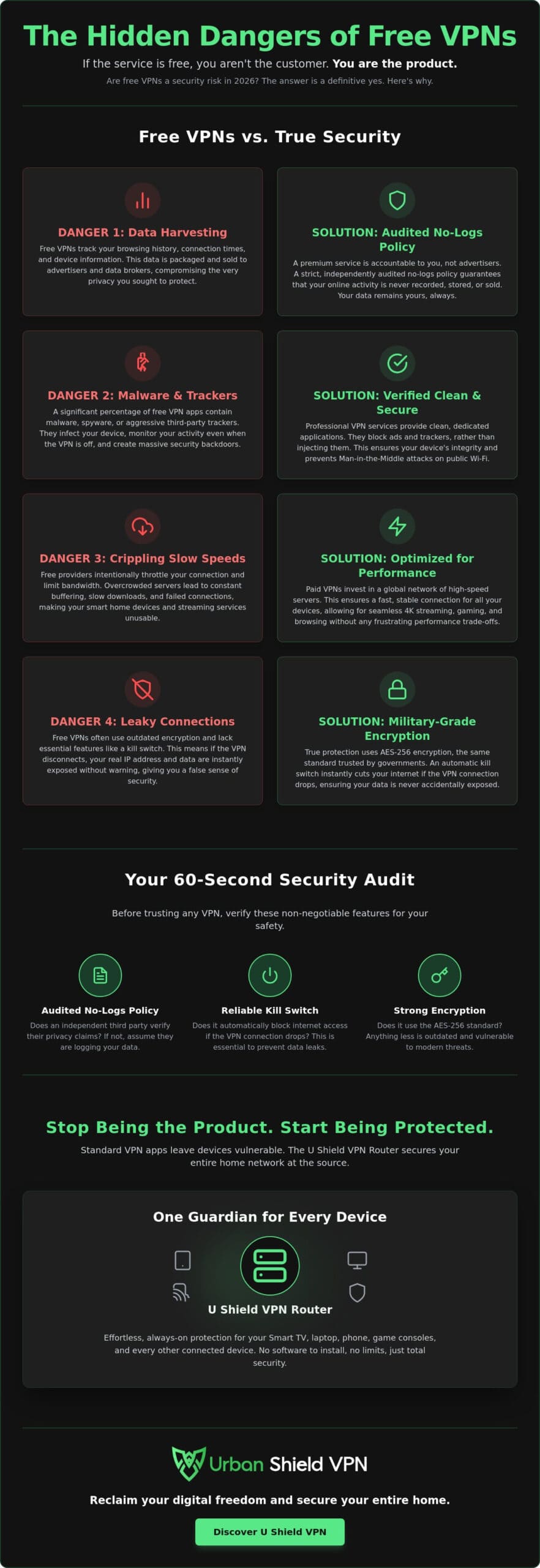
4 Hidden Dangers of Free VPN Providers
Free services don’t just leave you vulnerable. They actively compromise your system. When asking are free VPNs a security risk, consider that these providers must monetize your presence. They turn your digital footprint into a commodity. This isn’t just about seeing a few extra ads. It’s about deep-level access to your personal life. Security should be a silent guardian, but free software often acts as an intruder.
Data Harvesting: The Invisible Auction
Most free VPNs lack strict “No-Logs” policies. They track every site you visit and every file you download. This history is packaged and sold to data brokers in a continuous invisible auction. These brokers use sophisticated algorithms to re-identify “anonymous” data. Your identity is often just a few data points away from being exposed. Real security requires a Military Grade Encryption VPN to ensure your data stays yours. Without it, you are simply broadcasting your habits to the highest bidder. Protection should be total, not a compromise.
Malware and Third-Party Trackers
Many free apps act as digital trojans. They come bundled with aggressive tracking software that bypasses your standard privacy settings. Research into the dangers of free VPN providers shows that a significant percentage of free apps contain malware or hidden trackers. These trackers monitor your movements even when the VPN is turned off. A VPN should act as a guardian, not a spy. Using a compromised or unsecured free server also invites Man-in-the-Middle attacks. This allows third parties to intercept your passwords, emails, and banking details in real-time. It is a risk that no user should take.
Beyond data sales, some providers engage in bandwidth theft. They use your device as a secondary node for other users. This slows your connection and uses your residential IP address for someone else’s activity. If that user performs illegal actions, the digital trail leads directly back to your home. This is a primary reason why are free VPNs a security risk is such a critical question for modern families. Your reputation and your network are at stake.
Browser hijacking is another common tactic used by low-tier providers. You may notice unwanted ads appearing on every page or redirected searches that send you to suspicious websites. These changes compromise your user experience and expose you to further phishing risks. To avoid these traps, consider the U Shield VPN App for a clean, secure connection. True privacy means removing obstacles, not adding them. Investing in professional protection ensures your digital life remains fast, private, and entirely under your control.
Performance Gaps: Why Free VPNs Fail Your Smart Home
Your smart home is a delicate ecosystem of connected devices. It relies on speed, stability, and constant uptime. Free VPN services often shatter this balance. They prioritize profit over your user experience. Most free providers use intentional throttling to choke your bandwidth. This is a calculated move to frustrate you into a paid upgrade. When you ask, are free VPNs a security risk, you must consider the physical safety of your home network. A slow connection isn’t just an inconvenience. It causes security gaps during critical updates and leaves your home vulnerable during connection drops.
The “Buffering Trap” is a direct result of overcrowded, limited server networks. Free services pack thousands of users onto a handful of low-quality servers. This ruins 4K streaming and makes competitive gaming impossible. You face constant “re-logging” prompts and sudden disconnects. These interruptions expose your real IP address every time the software fails. Reliable protection should be invisible. It should stay in the background without forcing you to manage it constantly. High-speed, unlimited data is a standard for modern living, not a luxury reserved for those who can navigate complex settings.
The Weakest Link: Your Smart TV
Most IoT hardware lacks the processing power for standalone apps. You cannot simply install a free VPN on a Smart TV, a security camera, or a smart fridge. This leaves a massive hole in your defenses. Unencrypted data flows freely from these devices, providing a clear path for intruders. Free services ignore these “silent” devices entirely. To fix this, you need a solution that covers every connection at the source. Understanding network-wide VPN protection is the only way to ensure your entire home stays private. One weak link can compromise your entire digital life.
Streaming and Latency Issues
Major streaming platforms easily identify and blacklist free server IP addresses. This leads to the “proxy detected” error that ruins your evening. Beyond access, latency is the silent killer of productivity. High ping times make video calls lag and gaming unplayable. Are free VPNs a security risk when they fail to support your daily tasks? Yes, because they often force users to turn off protection just to get basic functionality. You shouldn’t have to choose between a fast connection and a secure one. Professional-grade tools provide the velocity you need with the strength your family deserves. Real security empowers your lifestyle; it doesn’t hinder it.
Spotting the Red Flags: A 60-Second Security Audit
You don’t need a degree in cybersecurity to protect your home. A 60-second audit can reveal if your current setup is a liability. Most people overlook the technical fine print when downloading software. When evaluating these tools, you must ask: are free VPNs a security risk for your family’s sensitive data? Start by checking for a transparent, third-party audited “No-Logs” policy. If a provider cannot prove they don’t store your history, they likely use it for profit. Next, verify the encryption standard. Demand AES-256 as your baseline. It is the industry gold standard for a reason. It provides the strength needed to keep your connection invisible to intruders.
Investigate the business model behind the software. If there is no subscription fee, how do they pay for global server maintenance? Often, they sell your bandwidth or browsing habits to advertisers. You should also test for DNS and IP leaks using independent tools. A DNS leak occurs when your browser sends requests outside the encrypted tunnel. This tells your ISP exactly which websites you visit. If your real IP address appears during a test, the software is failing its most basic job. This exposure is a primary reason why are free VPNs a security risk in the modern digital age. Reliable protection shouldn’t have holes.
The Kill Switch Essential
A VPN without a kill switch is a major security risk. Connections inevitably drop, even on the most stable networks. Without this feature, your device immediately reverts to your standard, unencrypted ISP connection. This exposes your data in milliseconds. You won’t even realize you’re vulnerable until it’s too late. No kill switch, no true privacy. It is the final line of defense for your digital life. It ensures that if the secure tunnel fails, your internet access stops instantly to prevent data leaks. This level of automation is vital for peace of mind.
Ownership and Jurisdiction
Jurisdiction dictates the laws governing your data. Companies based in “Five Eyes” countries may be legally forced to share user information with government agencies. Beware of “ghost companies” behind popular free apps. These often lack a physical address or a clear ownership structure. This lack of transparency is a massive red flag. You should always look for “military-grade” protection as your absolute baseline. It signals a commitment to high-level security protocols that free services simply can’t match. True safety requires a provider that is accountable to you, not a hidden corporate entity, a standard of transparency and reliability also found in professional security firms like Broadway Security Services.
If you want to bypass these risks entirely, you can secure your entire network with a U Shield VPN Router. This hardware solution removes the guesswork from your security audit by protecting every device at the source.
Beyond the App: Why Hardware is the Ultimate Shield
Software apps alone are no longer enough for a modern household. You have already identified the red flags. You understand the answer to the core question: are free VPNs a security risk? They are. But even the most reputable apps have a hidden flaw. They require manual effort. Installing, updating, and logging into software on every individual phone, tablet, and laptop leads to “app fatigue.” It is a technical chore that many people eventually abandon. The U Shield VPN Router eliminates this burden entirely. It acts as a permanent hardware guardian for your entire household. This plug-and-play solution secures every connection in your home at the source. You set it up once and enjoy immediate peace of mind.
This hardware-first approach removes the need for risky free trials. You no longer have to worry about software updates or connection drops on specific devices. One single login provides total, network-wide anonymity. It is the most efficient way to manage your digital footprint. By moving the protection to your router, you create a fortress that covers every square inch of your property. This is security simplified. It is protection that respects your time and your privacy. You don’t have to be a tech expert to achieve high-level safety. You just need the right tools, including SafeKeep to organize and secure your essential life documents alongside your network.
Total Home Protection
Most “smart” devices don’t support VPN apps. Your Smart TV, gaming consoles, and security cameras are often left completely exposed to trackers. The U Shield VPN Router secures these IoT devices automatically. It follows a “silent guardian” philosophy; much like how you can discover Letstrack for innovative GPS and IoT tracking software, this hardware ensures you stay protected without lifting a finger. Every byte of data leaving your home is encrypted before it even reaches the web. This is the only way to ensure 100% coverage for your family. To learn more about this technology, explore The Ultimate Guide to Pre-Configured VPN Routers in 2026. It is time to close the gaps in your defense.
Premium Performance, No Compromise
Speed is the ultimate benefit of professional hardware. Free servers are overcrowded and intentionally slow. A dedicated Monthly VPN Plan or Annual VPN Plan gives you a massive performance edge. You gain access to high-speed global servers optimized for 4K streaming and competitive gaming. There is no buffering. There is no lag. This is an investment in peace of mind and daily efficiency. You deserve a connection that is as fast as it is secure. Stop settling for the dangers of “zero” and choose a solution that actually works for your lifestyle. Are free VPNs a security risk you are willing to take? Upgrade to U Shield VPN for total security today and experience the power of a truly private home.
Reclaim Your Digital Sanctuary
The choice between convenience and security is a false one. We’ve seen how “free” services often turn your personal life into a commodity sold to the highest bidder. These tools prioritize data brokers over your family’s safety. When you ask, are free VPNs a security risk, the evidence points to a clear yes. You deserve a connection that’s fast, private, and entirely effortless. True protection shouldn’t require constant management or complex technical expertise. It should operate as a silent guardian in the background of your home.
Choosing a hardware-level solution means protecting every device from Smart TVs to gaming consoles without lifting a finger. You gain the strength of military-grade AES-256 encryption and the velocity of a high-speed global server network. It’s time to move beyond the limitations of unreliable apps and embrace total network-wide security. This is plug-and-play peace of mind designed for 2026. You can secure your entire home with the U Shield VPN Router today. Reclaim your digital freedom and enjoy a faster, safer internet. Your privacy is a right, not a luxury.
Frequently Asked Questions
Is it ever safe to use a free VPN for banking?
Using a free VPN for banking is never recommended. These services often lack the robust, modern encryption needed to shield sensitive financial transactions. They may use outdated protocols that leave your account details vulnerable to interception. Professional-grade protection ensures your banking sessions remain private and entirely secure, especially when you discover Ellicash to manage international investments and global stocks from your mobile device.
Can a free VPN steal my passwords or credit card info?
Yes, a free VPN can compromise your most sensitive credentials. Some malicious providers use “Man-in-the-Middle” attacks to capture passwords and credit card numbers as they pass through their servers. They act as a bridge that can see everything you type. This is a primary reason why many users ask: are free VPNs a security risk for their families.
Do free VPNs sell my browsing history to third parties?
Most free providers sell your browsing history to third-party data brokers. This is how they fund their operations without charging a subscription fee. They track the sites you visit and the time you spend online to build a profitable advertising profile. Your privacy is traded for their profit in a continuous invisible auction.
Why is my internet so slow when I use a free VPN?
Slow speeds are usually the result of overcrowded servers and intentional bandwidth throttling. Free providers limit your connection to manage their costs and pressure you to upgrade to a paid plan. This leads to the buffering and lag that ruins streaming and gaming. High-speed global servers are typically reserved for premium, paid services.
What is the best alternative to a free VPN for my home?
The best alternative is a dedicated, paid security solution like the U Shield VPN App or a hardware-based router. These tools prioritize your privacy with a strict no-logs policy and military-grade encryption. They provide a silent, powerful guardian that doesn’t compromise your connection speed or sell your personal habits to advertisers.
Is a VPN router better than a free VPN app for my family?
A VPN router is significantly more effective than a standalone app. It secures every device in your home at the source, including those that don’t support traditional software. This removes the “app fatigue” of managing individual connections on every phone and tablet. It’s a permanent shield for your entire family’s digital life.
How do free VPNs make money if they don’t charge users?
Free VPNs monetize your presence through data harvesting and aggressive ad injection. Some even sell your device’s idle bandwidth to other users, turning your home network into a node for strangers. If you aren’t paying for the service, your personal information is the currency they use to stay in business.
Will a free VPN work on my Smart TV or gaming console?
Most Smart TVs and gaming consoles don’t support free VPN apps. These devices lack the necessary interface to install third-party software, leaving your entertainment center and IoT devices completely exposed to trackers. A hardware solution like the U Shield VPN Router is the only way to cover these “silent” devices effortlessly.
