
What if the only thing standing between you and your favorite global shows wasn’t a technical glitch, but a legal misunderstanding? You’ve likely seen the “Content Not Available” message and wondered if there’s a better way. Many people ask, are VPNs legal for streaming, especially when they fear a legal notice or a sudden fine. The truth is simpler and more reassuring than the rumors suggest. In the vast majority of countries, including the US and UK, using a VPN is a perfectly legal way to protect your digital privacy. It’s about securing your data, not breaking the law.
It’s frustrating to pay for subscriptions only to find half the library locked away. We understand that you want to explore the internet without looking over your shoulder. This guide will clear the confusion around VPN legality and show you how to stream securely on any device. You’ll learn the difference between national laws and streaming service rules. We also explain how to protect Smart TVs that don’t support standard apps. It’s time to claim the peace of mind you deserve while enjoying global content with total confidence.
Key Takeaways
- Privacy is a fundamental right. Using a VPN is 100% legal in the UK, USA, Canada, and most of Europe.
- Distinguish between rules and laws. Violating a streaming service’s terms of use is a contract issue, not a crime.
- Travel with confidence. Identify exactly which countries restrict or ban VPN technology before you log on.
- Secure every device. Discover how pre-configured routers protect Smart TVs and home theaters without native app support.
- Gain total clarity. Use this 2026 guide to understand exactly where are VPNs legal for streaming and how to use them safely.
The Legal Status of VPNs for Streaming in 2026
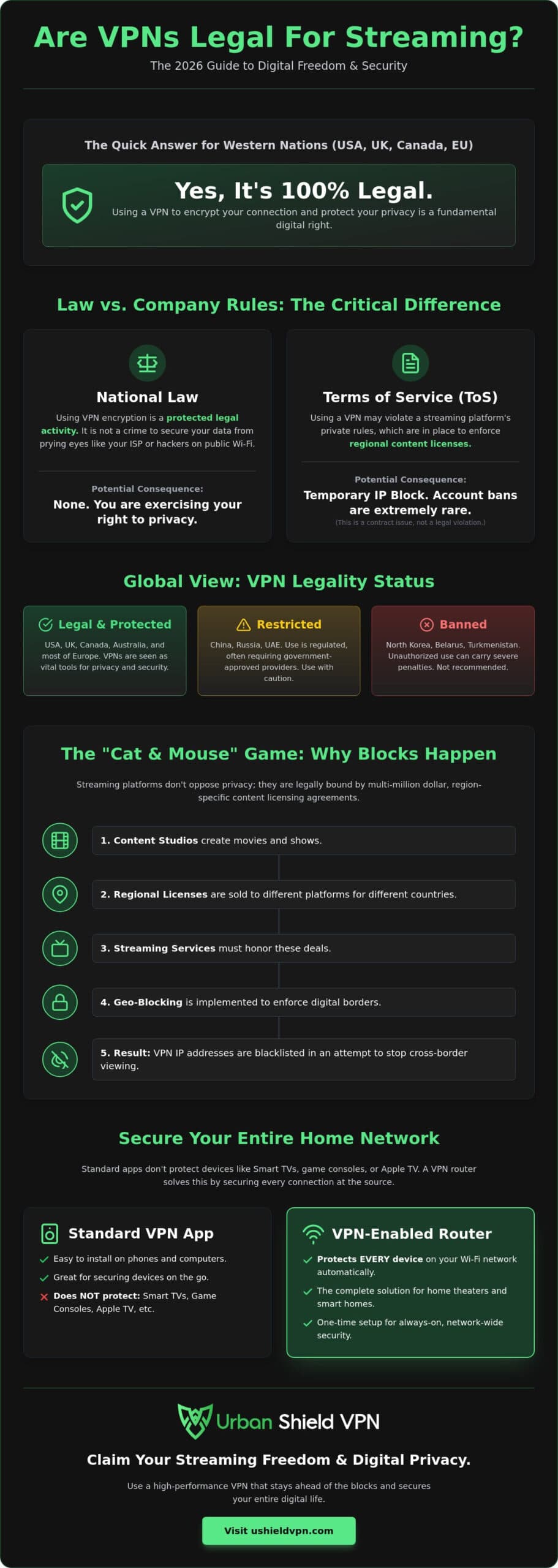
Privacy is a fundamental right. Encryption is the tool that secures it. If you’re asking, are VPNs legal for streaming, the answer in the West is a resounding yes. In 2026, using a VPN for encryption and IP masking remains a protected legal activity in all major democratic nations. This includes the UK, USA, Canada, and most of Europe. These governments recognize that digital security is not a luxury; it is a necessity for modern life.
It’s vital to distinguish between the tool and the action. A VPN is a piece of technology, much like a curtain on your window. Owning a curtain is legal. What you do behind it still falls under the law. Using a VPN to protect your connection while watching your favorite shows is a standard security practice. It keeps your data safe from prying eyes and secures your digital footprint. Most people use these tools to ensure their ISP doesn’t throttle their speeds or sell their browsing habits to the highest bidder.
Why Governments Support VPN Usage
Modern economies rely on the internet. Governments encourage VPN use to protect against massive data breaches and identity theft. This is especially true on public networks where hackers often wait for easy targets. Secure remote work infrastructures are now the backbone of national economic stability. By using a military grade encryption VPN, individuals take personal data sovereignty into their own hands. This reduces the burden on public cybersecurity resources. It creates a more resilient digital environment for everyone. When you secure your home network, you are contributing to a safer global web.
When Does Using a VPN Become Illegal?
The “Double-Edge” rule applies here. Legal tools do not grant immunity for illegal acts. Using a VPN to facilitate cybercrime, hacking, or the distribution of illicit material is always against the law. Privacy does not equal a license for digital piracy. While you are asking are VPNs legal for streaming, remember that the legality covers the encryption itself. Understanding how VPN blocking works helps clarify why some entities try to restrict access. They often target specific illegal behaviors rather than the technology itself. If your activities are legal without a VPN, they remain legal with one. The technology is a shield for your privacy, not a cloak for criminal activity.
Terms of Service vs. The Law: The Streaming Grey Area
Confusion often stems from the difference between a country’s laws and a company’s rules. When you ask, are VPNs legal for streaming, you must look at two different playbooks. The first is criminal law. In most democratic nations, no law prevents you from using encryption. The second is the “Terms of Service” (ToS) provided by platforms like Netflix, Hulu, or Disney+. These are private contracts. Violating a ToS is a breach of contract, not a violation of criminal law. You aren’t breaking a statute; you’re simply stepping outside the service’s preferred usage guidelines.
Streaming platforms don’t block VPNs because they hate privacy. They do it because of pressure from copyright holders. Licensing agreements are incredibly specific. A studio might sell the rights for a movie to Netflix in the UK, but to a different broadcaster in the USA. To keep these multi-million dollar deals intact, streaming services must show they are “attempting” to block cross-border access. This creates a perpetual “Cat and Mouse” game. Platforms blacklist known VPN IP addresses, while high-performance providers constantly deploy fresh, undetected servers to maintain access. It is a technological race that prioritizes user freedom against rigid corporate boundaries.
Can You Be Banned for Using a VPN?
Many users fear losing their accounts forever. Here is the reality check. Most services block the specific IP address of the VPN server, not the individual user account. It is extremely rare for a paying customer to be permanently banned for using a privacy tool. Platforms want your subscription revenue. They simply need to satisfy their licensing partners by making VPN usage a bit more difficult. Choosing a VPN for streaming that features optimized server rotations is the best way to ensure your connection remains stable. You get the privacy you need without the frustration of a “proxy detected” error.
Licensing Agreements and Geo-Blocking
Content is sold by region. A hit show might be a “Netflix Original” in Europe but belong to a local cable network in the States. Streaming services have a legal obligation to enforce these digital borders. For frequent travelers, this is a major pain point. You pay for a subscription at home, yet you lose access to your favorite shows the moment you cross a border. A VPN acts as a legitimate bridge for travelers. It allows you to access the library you already pay for, regardless of your physical location. It restores the full value of your subscription by removing artificial geographic barriers. If you want a permanent solution for your home theater, a U Shield VPN Router provides an invisible, always-on connection for every device you own.
Global Regulations: Where is VPN Streaming Restricted?
Digital freedom is not universal. While the West remains open, several nations enforce strict boundaries on how you access the web. If you’re asking, are VPNs legal for streaming while traveling, the answer depends entirely on your coordinates. In 2026, international regulations have become more sophisticated. Some countries have moved toward total bans, while others use advanced filtering to control access. Understanding these boundaries is the only way to ensure your peace of mind abroad.
Total Ban Countries include North Korea, Belarus, Iraq, and Turkmenistan. In these regions, using any anonymizing technology is a direct violation of national law. Belarus has prohibited these tools since 2015, and Iraq followed in 2014. Restricted Usage Countries like China, Russia, Iran, and the UAE operate in a different way. They don’t always ban the technology, but they strictly control which providers you can use. For example, unauthorized VPN use in China can lead to fines of up to ¥15,000. In Russia, a new policy effective May 1, 2026, even allows mobile operators to charge users specifically for VPN usage.
Obfuscated servers are the primary defense in high-censorship zones. These specialized servers scramble your VPN metadata. They make your encrypted tunnel look like standard, unencrypted HTTPS traffic. This technique is vital for maintaining connectivity where standard VPN protocols are easily flagged and blocked. It allows you to stay connected to the global web without triggering automated filters.
Understanding Local Internet Laws
State-approved VPNs differ significantly from private, encrypted tunnels. Approved versions often include backdoors for government monitoring. This defeats the purpose of true privacy. Private tunnels remain the gold standard for data sovereignty. Interestingly, corporations in China are still allowed to use VPNs for business. These are registered, high-level lines necessary for international commerce. For the average traveler in 2026, the legal landscape is complex. Always research your destination before you pack. Installing your security software before you cross the border is a critical step for modern travel.
Enforcement and Real-World Consequences
ISPs now use Deep Packet Inspection (DPI) to detect VPN traffic. This technology looks inside data packets to identify encryption signatures. While there is a global shift toward fining providers rather than individual users, personal risks still exist for residents in restrictive zones. Turkey recently passed a law in April 2026 that allows the government to throttle bandwidth for non-compliant platforms. Using a pre-configured VPN router provides a more discreet footprint. It secures your entire home network at the source. This makes it much harder for ISPs to pinpoint specific VPN usage on individual devices. It acts as a silent guardian for your home theater. Knowing are VPNs legal for streaming in your specific region ensures you stay on the right side of the law while enjoying your favorite content.
Protecting Your Streaming Setup: App vs. Router
You now know the facts: are VPNs legal for streaming in the West? Yes. The next challenge is implementation. Most users start with a standalone app. VPN apps offer mobile flexibility and quick encryption for phones or laptops. They are excellent for travelers. However, they often fail in the home theater. Modern streaming setups involve multiple devices, many of which don’t allow you to install third-party security software directly.
The “Smart TV problem” is a major hurdle for digital privacy. Many popular devices like older LG or Samsung TVs lack native VPN support. Hardware-level encryption is the gold standard for 2026 home security. It removes the technical burden from the individual device. A VPN router secures the source of your internet, protecting every connected device without individual app installations. This approach creates a silent, powerful guardian for your entire household. It ensures that your privacy is always active, regardless of which screen you turn on.
Securing Devices Without Native Apps
You can protect Apple TV, PlayStation, and Xbox instantly. These devices are notoriously difficult to secure because they don’t support standard VPN apps. Most people resort to “Smart DNS” workarounds. These are complex, unreliable, and don’t provide actual encryption. By shifting to network-wide VPN protection, you eliminate these technical headaches. Every IoT device, from your gaming console to your smart fridge, sits behind a secure tunnel. This unified defense simplifies your digital life. You no longer have to worry if each device is individually protected. The protection is automatic and invisible.
Why a Pre-Configured Router Wins
Plug-and-play simplicity is the ultimate benefit. A pre-configured router arrives ready to work. You don’t need to be a networking expert to secure your home. It also eliminates the risk of a “Kill Switch” failure common on mobile apps. If a mobile app crashes, your data might leak onto the open web. A router-level connection is more stable. It provides consistent high-speed streaming for the entire household. Everyone enjoys the same level of security and access simultaneously. If you’re ready to upgrade your home theater, the U Shield VPN Router offers the most reliable way to maintain your digital freedom. It ensures you never have to ask are VPNs legal for streaming on your specific hardware again; the answer is always a secure, high-speed “yes.”
U Shield VPN: Secure Your Streaming Freedom
Security should be effortless. You’ve navigated the complexities of global regulations and understood the difference between laws and contracts. By now, the answer to are VPNs legal for streaming is clear: it is a protected right in major democracies. U Shield VPN exists to turn that right into a reality. We provide the tools you need to reclaim your digital sovereignty without the technical headache. Our service acts as a silent, powerful guardian. It operates in the background, ensuring your data remains private and your entertainment remains accessible.
U Shield VPN utilizes military-grade encryption to protect your connection from every angle. This is the same level of security used by financial institutions to guard sensitive data. We apply this power to your home theater. Our global network features high-speed servers optimized specifically for 4K streaming and low-latency gaming. You get the protection you need without sacrificing the performance you expect. For those who demand the same high-performance standards in their physical gear as they do in their digital tools, you might check out 2XU for advanced athletic apparel. One login secures your entire digital life. It is professional security stripped of the intimidation factor.
The U Shield Hardware Advantage
Individual apps are useful, but hardware is the ultimate solution. Our pre-configured VPN router is the definitive “set and forget” choice for modern households. It encrypts your internet at the source. This means every device in your home is protected instantly. We include built-in anti-trackers and automatic kill switches. These features ensure maximum anonymity even if your connection blips. You avoid the common pitfalls of mobile software. There are no apps to crash and no settings to misconfigure. You simply enjoy fast browsing and unrestricted access. Our servers are designed to bypass ISP throttling, giving you the full speed you pay for every month.
Start Streaming Securely Today
True digital freedom shouldn’t be a chore. We offer flexible Monthly VPN Plan and Annual VPN Plan options to suit your lifestyle. Whether you need protection for a single trip or a permanent home solution, we have you covered. For those on the move, the U Shield VPN App provides the same high-level encryption for your mobile devices. Experience the peace of mind that comes with a truly private internet. You can finally stop worrying about are VPNs legal for streaming and start enjoying your content with total confidence. The obstacles are gone. The shield is ready.
Secure your home with a U Shield VPN Router today
Reclaim Your Digital Freedom
Internet privacy is a fundamental right, not a legal grey area. You now understand that using encryption is a protected activity in most of the world. While streaming services have their own rules, they don’t override national laws. The real question isn’t just are VPNs legal for streaming, but how you can implement them most effectively. Shifting from individual apps to a hardware-based solution ensures every device in your home stays secure. This approach removes the technical burden and provides a consistent, high-speed connection for your entire household.
True peace of mind comes from knowing your data is invisible. Our solution features military-grade AES-256 encryption and is optimized for 4K streaming and low-latency gaming. It arrives pre-configured for plug-and-play security. You don’t need to be a tech expert to enjoy a private web. Get the U Shield VPN Router for network-wide streaming protection. Take control of your digital borders today. Your favorite content is waiting, and your security is our priority.
Frequently Asked Questions
Is it illegal to use a VPN for Netflix in the UK?
No, it isn’t illegal to use a VPN for Netflix in the UK. Using encryption is a protected right for digital privacy. While it violates Netflix’s Terms of Use, this is a contractual matter rather than a criminal offense. You won’t face legal prosecution for simply securing your connection and protecting your data from prying eyes.
Can I get in trouble for using a VPN to watch sports?
You won’t face legal trouble in most countries for watching sports with a VPN. It’s a common way to maintain access to your home subscriptions while traveling abroad. However, if you are in a high-restriction zone like North Korea or Belarus, any VPN use carries significant risks. Always check local laws before connecting in restrictive regions.
Will my streaming account be banned if I use a VPN?
Permanent account bans are extremely rare for paying customers. Streaming platforms prioritize subscription revenue over enforcing minor contract breaches. Usually, the service simply blocks the VPN’s specific IP address. If you see a “proxy detected” error, switching to a fresh, undetected server typically restores your access immediately.
Are VPNs legal in the USA for accessing foreign content?
Yes, VPNs are legal in the USA for any privacy-related activity. The law doesn’t prohibit using encryption to mask your IP address or secure your traffic. While you might wonder are VPNs legal for streaming when bypassing geo-blocks, it remains a civil contract issue rather than a violation of federal law. It is a legitimate tool for personal data protection.
Is it safe to use a free VPN for streaming?
Free VPNs are generally unsafe and unreliable for high-quality streaming. These services often sell your browsing data to third parties to cover their operational costs. They also lack the expensive infrastructure needed for 4K video. You’ll likely experience constant buffering and frequent IP blacklisting from major streaming platforms that easily detect low-quality servers.
How do streaming services know I am using a VPN?
Platforms use sophisticated detection methods like IP blacklisting and identifying DNS leaks. If thousands of users share a single IP address from a known data center, the system flags it as a VPN. They also look for mismatches between your IP location and your device’s time zone. High-quality providers evade these checks by constantly rotating their server addresses.
Is using a VPN router more legal than using an app?
Both methods carry the same legal weight in all major democracies. A router simply provides a more comprehensive shield for your entire home network. It secures devices that don’t support native apps, like older Smart TVs and gaming consoles. This hardware-level approach ensures your privacy is always active without needing individual app management. When asking are VPNs legal for streaming, the answer remains the same regardless of your hardware setup.
Can the police track my streaming activity if I use a VPN?
A high-quality VPN makes it nearly impossible for anyone, including local authorities, to track your real-time activity. Military-grade encryption hides your data packets from prying eyes. This protection only works if your provider doesn’t store logs of your browsing history. Always choose a service that prioritizes total data sovereignty and invisibility to ensure your digital footprint stays private.
