



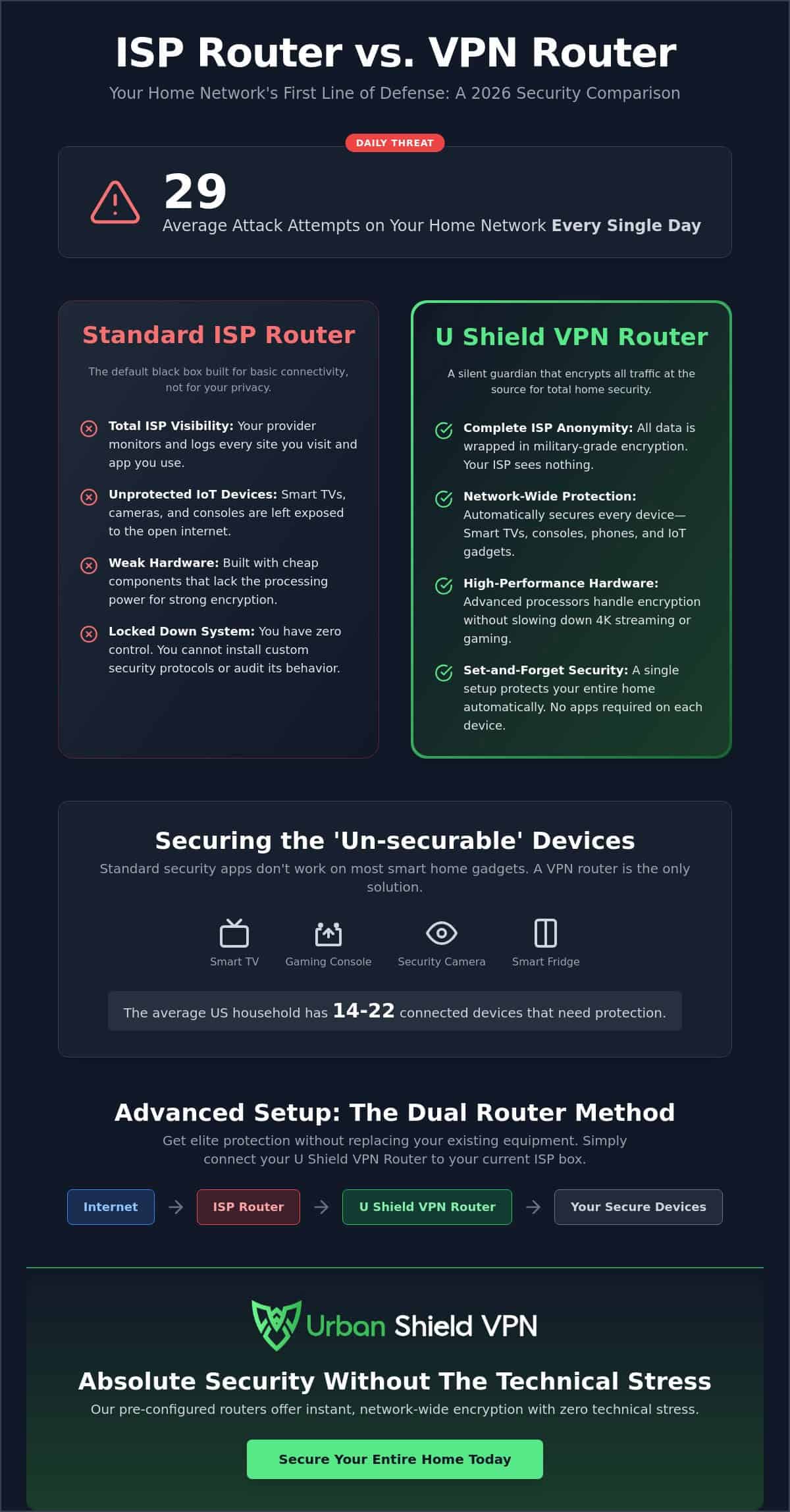
Your home network faces an average of 29 attack attempts every single day. It’s a staggering reality. Most families rely on the standard equipment provided by their internet company, but that black box is often your biggest vulnerability. It’s built for basic connectivity. It isn’t built to shield your private life from prying eyes.
You probably feel like your ISP knows too much about your browsing habits. You’re right. You might also worry about Smart TVs or IoT devices that lack built-in security. Comparing an ISP router vs VPN router is the first step toward reclaiming your digital freedom. We’ll show you exactly how to secure every device in your home without the headache of complex manual setups.
This guide explains the critical differences between standard hardware and advanced VPN routers. You’ll discover how to achieve network-wide protection and complete anonymity from your provider. We’re moving toward a future where security is silent, powerful, and completely effortless.
Key Takeaways
- Reclaim your privacy. Stop your internet provider from monitoring your browsing habits and data.
- Protect every device. Secure Smart TVs, consoles, and IoT gadgets that don’t support standard security apps.
- Compare your hardware. Understand the core differences in an ISP router vs VPN router to secure your home in 2026.
- Simplify the setup. Learn how the ‘Dual Router’ method provides elite protection without replacing your existing equipment.
- Automate your defense. Discover how pre-configured routers offer instant, network-wide encryption with zero technical stress.
What Is an ISP Router and Where Does It Fall Short?
Your internet service provider (ISP) usually provides a standard gateway box. It’s a modem and router combined into one. It’s designed to get you online quickly. It’s built for mass distribution. However, it isn’t built to protect your private life. When comparing an ISP router vs VPN router, the most critical difference is control. Most ISP devices are locked down. You can’t install your own security protocols. You can’t audit how it handles your data. It’s a closed system that serves the provider first and the user second.
These standard boxes often lack the raw processing power required for high-level security. Modern encryption takes work. It requires specialized chips to maintain fast speeds while scrambling your data. Standard ISP hardware is built with the cheapest components possible. This keeps their costs low, but it leaves your network slow and vulnerable. It’s a basic tool for a complex world.
The Hidden Cost of ‘Free’ ISP Hardware
Many providers offer these routers for a small monthly fee. Some even include them for free. The real price is your privacy. Your ISP sees every site you visit and every app you use. They can log your digital habits to build a detailed profile of your household. This information is a goldmine for advertisers. Without military grade encryption VPN protection at the source, your traffic is an open book to your provider. These devices also tend to use older Wi-Fi standards. This results in limited range and weaker signals in larger homes. You’re paying for a service that actively limits your potential.
Vulnerabilities in the Standard Home Network
Default settings are a hacker’s best friend. Most ISP routers ship with factory passwords that many users never change. Some even contain hard-coded backdoors that allow the ISP to access the device remotely. This creates a massive security risk. If the ISP can get in, a sophisticated attacker might too. Standard routers also fail to protect your Internet of Things (IoT) devices. Your Smart TV, smart fridge, and security cameras are often un-hackable from the inside. They don’t support security software. Understanding what a VPN is makes the solution clear. You need a device that secures the data before it ever leaves your home. Standard hardware leaves these devices exposed to the open web. It doesn’t block trackers. It doesn’t filter ads. It simply acts as a passive observer of your digital life. In the ISP router vs VPN router debate, the standard box is the clear weak link.
The VPN Router: A Silent Guardian for Every Device
The standard gateway provided by your internet company is a basic door. A VPN router is a high-tech vault. It takes every single bit of data from your household and wraps it in a protective shell before it ever reaches the street. This happens at the hardware level. It means your ISP sees nothing but encrypted code. When evaluating an ISP router vs VPN router, the advantage is clear. One device provides network-wide VPN protection without requiring you to install a single app on your phone or laptop. It is the ultimate set-and-forget security solution.
Modern hardware is built for this task. Older routers often struggled with the heavy math required for encryption. They would slow your connection to a crawl. In 2026, advanced processors ensure that your 4K streams and gaming sessions remain lag-free while staying completely private. You get the speed you pay for. You get the security you deserve. It operates in the background, a silent guardian for your digital life.
Securing the ‘Un-Securable’ Devices
The average US household now manages between 14 and 22 connected devices. Most of these, like your Smart TV, baby monitor, or smart fridge, cannot run security software. They are often the weakest links in your defense. A hardware-level shield is the only way to protect them. CNET’s guide on comparing VPN routers and apps notes that routers are the only way to cover devices that don’t natively support VPNs. This approach effectively closes the gap in smart home security. It also allows you to unlock global content on your gaming console or streaming box effortlessly. If you want a simpler way to protect your home, a U Shield VPN Router delivers total coverage with zero configuration stress.
Privacy at the Source
Every person in your home deserves privacy. A VPN router masks the IP address for every connected user simultaneously. It creates a unified front against tracking. These devices also feature built-in kill switches. If the VPN connection ever flickers, the router instantly cuts the internet. This prevents accidental data leaks. It also stops ISP throttling. Providers often slow down your connection when they detect heavy video streaming or large downloads. Since a VPN router hides the type of traffic you consume, your ISP cannot target your activities for slowdowns. You regain control over your bandwidth. You reclaim your anonymity. In the battle of ISP router vs VPN router, the hardware-level approach wins on every front.
ISP Router vs. VPN Router: The 2026 Comparison
Choosing between an ISP router vs VPN router is a choice between being a guest in your own home or the master of your domain. Your ISP router is a rental. It’s a tool they use to monitor your habits and restrict your settings. A VPN router is an investment in total digital sovereignty. It doesn’t just connect you; it protects you. By moving the security to the hardware level, you bypass the typical limits of software. Most VPN providers limit you to a handful of simultaneous connections. A VPN router counts as just one connection but secures every device in the house. It’s an elegant solution to a modern problem.
- Privacy: ISP routers log every DNS request. VPN routers mask your entire digital footprint.
- Control: ISP boxes are locked down. VPN routers give you full access to advanced networking features.
- Device Liberty: Secure your Xbox, Peloton, and smart lights without installing individual apps.
- Performance: Modern hardware eliminates the “VPN lag” that plagued older systems.
Technical Specs and Performance
Encryption is a heavy lift. Standard ISP routers use weak processors that can’t handle the mathematical demands of AES-256 bit encryption. This is why many people believe VPNs are slow. The truth is your hardware was simply too weak. High-performance VPN routers feature multi-core CPUs designed specifically for high-speed data scrambling. These devices now support Wi-Fi 7 standards. They offer massive bandwidth and lower latency for a house full of active users. When you use pre-configured VPN routers, you get enterprise-grade power in a consumer-friendly package. It’s professional security without the professional price tag.
Ease of Use and Maintenance
There is a common myth that advanced security hardware is difficult to manage. That’s a relic of the past. Modern interfaces are clean, visual, and intuitive. You don’t need a degree in network engineering to stay safe. While ISPs push manual firmware updates that often reset your settings, VPN routers handle updates automatically in the background. You manage your entire home through a single, secure dashboard. You can toggle locations, check speeds, and monitor connected devices with a few clicks. It’s sophisticated simplification at its best. You gain peace of mind without adding technical stress to your daily life. Your network stays updated. Your family stays shielded. The complexity stays invisible. In the battle of ISP router vs VPN router, the modern user chooses the device that works for them, not the provider.
Can You Use Both? The ‘Dual Router’ Setup Explained
Many homeowners believe they must choose one or the other. This is a misconception. You don’t have to replace your current equipment to gain elite privacy. In fact, the most effective strategy for 2026 is the “Dual Router” setup. This configuration allows your provider’s hardware to handle the signal while your security hardware handles the data. It’s the ultimate power move for your home network. You get the reliability of your provider and the protection of a dedicated shield. It turns the ISP router vs VPN router debate into a partnership that works for you.
Setting this up is a logical, step-by-step process. It removes the technical friction and puts you in control. Follow these four steps to transform your network:
- Step 1: Access your ISP hub settings and activate “Bridge Mode.” This disables its internal Wi-Fi and routing functions.
- Step 2: Connect an Ethernet cable from the LAN port of your ISP hub to the WAN port of your VPN router.
- Step 3: Log into your new, secure Wi-Fi network and connect all your household devices.
- Step 4: Enjoy total privacy. Your ISP now acts only as a transparent pipe, unable to see what happens inside your encrypted tunnel.
If you want to skip the manual configuration, a pre-optimized U Shield VPN Router is designed to plug directly into your existing hub and start protecting you instantly.
What is Bridge Mode and Why Does it Matter?
Bridge Mode is a critical setting that prevents “Double NAT.” This occurs when two routers try to manage your network at the same time. It often causes lag in gaming and buffering during 4K streams. By flipping this switch, you tell the ISP box to step aside and let the VPN router lead. This ensures maximum performance. It also allows you to keep using your ISP’s telephone or TV services. The hub still handles the signal for those specific services, but your internet traffic remains strictly under your control. It’s a clean, efficient division of labor.
The ‘Side-by-Side’ Alternative
Sometimes, you might want to run two Wi-Fi networks simultaneously. This is the “Side-by-Side” approach. You leave the ISP Wi-Fi active for guests or non-sensitive devices. You reserve the VPN Wi-Fi for your private data, banking, and smart home gadgets. This provides a secondary layer of isolation. To optimize this, keep the routers a few feet apart to prevent signal interference. This setup offers flexibility. You choose when to be invisible and when to use the standard connection. It’s the most versatile way to manage an ISP router vs VPN router environment in a modern, connected home.
U Shield VPN: Absolute Security Without the Technical Stress
The transition from a standard gateway to a protected home network shouldn’t be a chore. It should be a relief. U Shield VPN exists to bridge the gap between high-level security and everyday usability. We understand the technical burden of modern networking. We choose to carry it for you. While the ISP router vs VPN router debate often focuses on complex configurations, we focus on results. Our hardware arrives at your door pre-configured and ready for action. You gain a powerful, silent guardian that operates in the background. It secures your digital footprint with absolute precision.
Every device in your home deserves elite protection. From your tablets to your smart thermostats, U Shield VPN applies military-grade encryption to every byte of data. This isn’t just about privacy. It’s about peace of mind. We utilize high-speed global servers specifically optimized for high-demand tasks. You can enjoy 4K streaming and low-latency gaming without ever worrying about who is watching your traffic. It is sophisticated security. It values your time and your freedom. We take the technical weight off your shoulders so you can focus on what matters.
Plug, Play, and Disappear
Manual VPN setups are a thing of the past. You don’t need to flash firmware or write scripts to reclaim your privacy. Pre-configured hardware is the gold standard for modern homes. When you connect a U Shield VPN Router, you instantly vanish from ISP logs and advertiser trackers. Your data becomes a scrambled, unreadable tunnel. We also include a dedicated ‘Kill Switch’ promise. If the secure connection ever drops, your internet cuts out immediately. This ensures no data ever leaks into the open web. You stay protected. Whatever happens in the background stays there.
Your Protection, Simplified
One login provides total coverage for your entire family. You no longer have to manage individual apps or worry about device limits. Everything connected to your Wi-Fi is shielded. This simplifies your digital life and expands your entertainment options. You can access a VPN for streaming to bypass regional blocks and enjoy a truly global library of content. It’s unrestricted entertainment with zero compromise on safety. Take the first step toward a secure home today. Experience the power of a network that works for you, not your provider. Your digital sovereignty is just a plug-and-play away. In the choice between an ISP router vs VPN router, the path to freedom is clear.
Secure Your Digital Future Today
The choice is clear. Your provider’s hardware is a gateway for their interests. A dedicated VPN router is a fortress for yours. You now understand how a dual-router setup offers the best of both worlds. It provides elite, network-wide protection while keeping your connection fast and stable. Every device in your home can finally be secure.
Comparing an ISP router vs VPN router reveals a fundamental truth. Privacy is no longer a luxury; it is a necessity. You don’t need to be a networking expert to reclaim your data. You just need hardware that prioritizes your family over your provider’s bottom line. The complexity of digital defense has been removed, leaving you with total control.
Secure your entire home with the U Shield VPN Router. Benefit from military-grade AES-256 encryption on every connected device. Our plug-and-play setup requires zero technical skills. Every unit is optimized for 4K streaming and low-latency gaming. It is the silent, powerful guardian your home deserves.
You deserve a network that protects your freedom. Take the final step toward absolute peace of mind. Your secure home is ready.
Frequently Asked Questions
Will a VPN router replace my ISP router entirely?
No, a VPN router typically works in tandem with your existing equipment. Your ISP device remains the physical entry point for the internet signal. The VPN router then connects to it to encrypt and distribute data across your home. This “Dual Router” setup ensures you maintain your provider’s technical support while gaining the privacy you deserve. It is a partnership that prioritizes your security.
Is it difficult to set up a VPN router if I’m not a tech expert?
Setup is effortless when you choose a pre-configured solution. You don’t need to be a network engineer to reclaim your privacy. Most modern devices are plug-and-play. You simply connect the cables and log in to your new secure network. We handle the complex math and configuration in the background so you can enjoy instant protection without any technical stress.
Does a VPN router slow down my internet speed for gaming?
Modern VPN routers use powerful processors that eliminate noticeable lag. While encryption requires some overhead, high-performance hardware handles this task in milliseconds. This is a major factor in the ISP router vs VPN router comparison. You maintain the low latency required for competitive gaming while ensuring your connection remains completely anonymous and shielded from external threats. Speed and security now coexist.
Can I still use my ISP’s TV and phone services with a VPN router?
Yes, your specialized provider services remain fully functional. By using Bridge Mode, your ISP hub continues to manage dedicated TV and phone signals while passing internet traffic to the VPN router. You don’t have to sacrifice your landline or cable package to secure your digital life. It is a seamless integration that provides the best of both worlds for your modern household.
Do I need a separate VPN subscription for my phone if I have a VPN router?
You only need a separate app for your phone when you leave the house. While connected to your home Wi-Fi, the router protects your phone automatically. For security on the go, a U Shield VPN App is necessary to maintain protection on public networks or mobile data. Additionally, if you’re traveling and need a reliable data connection, you can visit Always Mobile for prepaid eSIM plans that work internationally. One account typically covers both your home hardware and your mobile devices for continuous defense.
What happens if the VPN connection drops on the router?
A built-in Kill Switch ensures your data never leaks. If the secure tunnel fails, the router instantly disconnects your internet. This prevents your devices from reverting to an unencrypted connection that your ISP could monitor. Your privacy remains intact until the secure link is restored. It is a fail-safe mechanism designed for absolute peace of mind and total data integrity.
Is a pre-configured VPN router better than a DIY setup?
Pre-configured hardware is the superior choice for most users. DIY setups often involve “flashing” firmware, which can void warranties or break the device if done incorrectly. A pre-configured ISP router vs VPN router solution arrives optimized for speed and security right out of the box. You get professional-grade defense without the technical risk or time investment. It is the gold standard for home security.
Can I secure my Smart TV without installing a VPN app?
Yes, every device connected to the VPN router is automatically protected. This includes Smart TVs, gaming consoles, and smart home gadgets that don’t support traditional apps. You simply connect the TV to your secure Wi-Fi network. The encryption happens at the source. You can stream global content and block trackers without navigating complex TV menus or app stores. It is total coverage simplified.
