


You settle into your hotel after a long flight, ready to stream the latest episode of your favorite show. Instead of the opening credits, a cold message appears: “This content is not available in your region.” It is a frustrating wall that many travelers hit. Learning how to avoid geo-blocking on vacation is the only way to ensure your home library follows you across borders.
You pay for your subscriptions. You should be able to use them. We know the stress of slow hotel Wi-Fi and the nagging fear of hackers on open airport networks. This guide promises a simple path to unrestricted access and total data protection. You will learn how to secure your entire family with one connection and enjoy buffer-free 4K streaming anywhere in the world.
We will explore how hardware-level encryption simplifies your digital life. You will learn to navigate the 2026 legal landscape, including new privacy protections like California’s AB-45. From the U Shield VPN Router to the latest post-quantum encryption, we provide the tools for a fast, private, and borderless journey. Your security should be effortless. We are here to make it happen.
Key Takeaways
- Understand how digital borders restrict your content and why IP masking is the key to regaining access.
- Discover the exact steps to avoid geo-blocking on vacation for seamless streaming across all your favorite platforms.
- Compare the portability of the U Shield VPN App with the plug-and-play power of a pre-configured VPN router.
- Protect every family device from public Wi-Fi threats with a single, high-speed encrypted connection.
- Follow a proven 2026 travel checklist to guarantee buffer-free 4K video quality before you leave home.
Understanding Geo-Blocking: Why Your Favourite Shows Vanish Abroad
Geo-blocking is the digital enforcement of geographical borders on the internet. It is an invisible barrier that dictates what you can and cannot see based on where you are standing. When you cross a border, the streaming services you pay for often change their behavior. You might find your favorite series replaced by a “content unavailable” message. This happens because platforms use your internet connection to identify your precise location. To effectively avoid geo-blocking on vacation, you must understand the technology that builds these walls.
The primary reason for these restrictions is licensing. Media companies sell the rights to movies and shows on a country-by-country basis. These agreements force streaming giants to show different libraries in different regions to maximize profit. It is a complex legal web that treats the internet like a series of isolated islands. You can learn more about what geo-blocking is and how it impacts global trade through official documentation. For the traveler, it simply means your subscription doesn’t travel as well as you do.
Websites scan your connection for location markers the moment you arrive. They look for your IP address, your time zone, and even your language settings. If these markers don’t match the local licensing rules, the platform blocks your access. It is an automated, ruthless process that happens in milliseconds.
How Your Location is Leaked
Your IP address acts as a digital home address for every site you visit. It is the most common way your location is leaked. Even if you use a simple proxy, your DNS requests can still whisper your true origin to the server. By 2026, tracking has become even more precise. Many mobile apps now use GPS data and Wi-Fi triangulation to verify your spot. These secondary checks ensure that “spoofing” your location requires a more robust, professional solution than a basic browser extension.
The Impact on Travellers in 2026
Missing out on home-country news or live sports is a common frustration for modern travelers. You shouldn’t lose access to the services you pay for just because you are abroad. There is also a significant security element to consider. Many travelers try to avoid geo-blocking on vacation by using free, untrustworthy tools. These “free” services often sell your browsing data or lack the encryption needed to keep you safe on hotel networks. In 2026, with new privacy laws like California’s AB-45 and Connecticut’s CTDPA, protecting your geolocation data is more critical than ever. Using an unverified tool to bypass a block can leave your private information exposed to hackers.
The frustration of a dark screen is only part of the problem. Your digital identity is at risk when you use subpar methods to regain access. You need a solution that offers both freedom and total security. Understanding these risks is the first step toward a better, more private travel experience.
How a VPN Bypasses Regional Restrictions Seamlessly
A VPN is your digital passport for the modern age. It works by creating an encrypted tunnel between your device and a remote server located in your home country. This tunnel acts as a private lane on the public highway of the internet. When you connect, your real IP address is instantly replaced with one from the VPN server’s location. Websites and streaming platforms only see the server’s address, which grants you immediate access to your local content library. This is the most reliable method to avoid geo-blocking on vacation while keeping your personal data out of reach from local observers.
The transition is invisible to the user but powerful in its execution. By masking the “location markers” we discussed earlier, the VPN removes the digital borders that usually restrict your viewing. It is a solution built on the principle of freedom. You shouldn’t be penalized for traveling, and a high-quality VPN ensures your digital life remains consistent regardless of your physical coordinates. For those ready to secure their journey, the U Shield VPN App provides this protection with a single tap.
Virtual Relocation Explained
Virtual relocation allows you to sit in a hotel in Spain while your device appears to be in London or New York. You simply select a server in your home city, and the network does the rest. However, not all networks are equal. High-bandwidth global servers are essential for modern travelers. Streaming in 4K requires massive data throughput, and a weak connection will lead to constant buffering. Since a VPN can reduce internet speed by around 50% under regular conditions, starting with a high-speed infrastructure is vital. Modern protocols like WireGuard, which operates on a streamlined 4,000 lines of code, help maintain the velocity you need for buffer-free video. You can find detailed advice on how to use a VPN to stream to ensure your setup is optimized for your destination.
Encryption: The Invisible Protector
Security is the silent partner of accessibility. A military grade encryption VPN wraps your entire connection in a protective layer that hotel ISPs cannot penetrate. This prevents “man-in-the-middle” attacks, a common threat on open airport and hotel Wi-Fi where hackers intercept your data. Your passwords, banking details, and private messages stay encrypted and unreadable. Reliability is also a key feature; a built-in Kill Switch ensures that if your VPN connection drops, your internet is cut immediately. This prevents your real location from leaking to the websites you are visiting. In 2026, this level of protection is a necessity for anyone looking to avoid geo-blocking on vacation without compromising their digital safety.
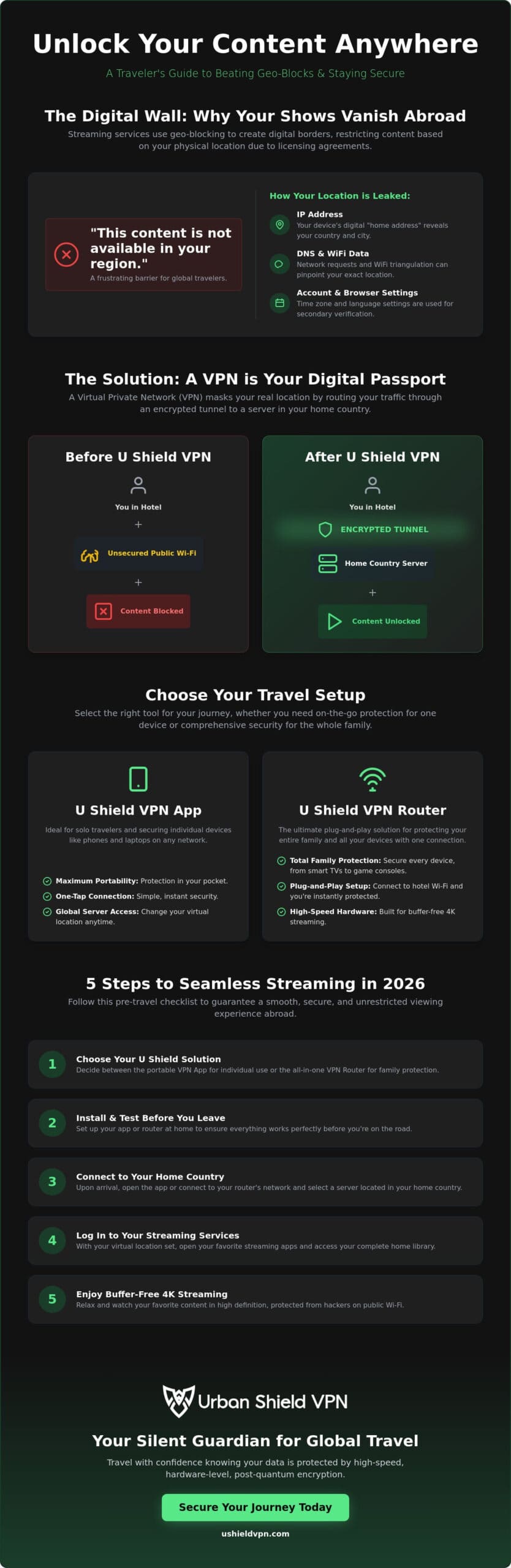
VPN App vs. VPN Router: Choosing Your Travel Setup
Selecting the right tool for your trip is the difference between a seamless experience and a technical headache. While most people reach for a mobile app, it isn’t always the most efficient choice for a hotel room. A VPN app vs VPN router comparison reveals significant differences in ease of use and overall performance. Apps work well for individual devices, but they struggle to protect an entire family’s digital footprint. A dedicated router offers hardware-level protection that covers every device in the room with a single, stable connection.
Hardware solutions remove the friction of digital security. You don’t need to install software on every family member’s device or worry about individual login limits. Instead, the router acts as a silent, powerful guardian for your local network. It is the most robust way to avoid geo-blocking on vacation while ensuring your data remains private. By moving the encryption task to a dedicated device, you free up your phone and laptop for what they do best: entertainment and communication.
The Limitations of Mobile Apps
Mobile apps are convenient but come with hidden costs. Running high-level encryption on a smartphone causes significant battery drain. Your device has to work harder to process data, which leads to heat and slower performance. There is also the issue of compatibility. Many popular streaming devices, such as Apple TV, Chromecast, or game consoles, don’t support native VPN apps. If you want to avoid geo-blocking on vacation on the big hotel screen, an app often leaves you stranded. Most VPN providers also limit the number of simultaneous logins, which creates a bottleneck for families traveling with multiple tablets and phones.
Why a Portable VPN Router Wins for Vacation
A portable VPN router, like the U Shield VPN Router, is a game changer for frequent travelers. You simply plug it into the hotel Ethernet port or connect it to the local Wi-Fi to create your own secure, private hotspot. It acts as a bridge between the public network and your personal devices. Pre-configured settings mean you face zero technical stress upon arrival. Once your devices are linked to the router, they stay protected for the duration of your trip. This setup allows for seamless VPN for streaming on every device simultaneously. Whether it is a tablet in the bedroom or a laptop at the desk, the protection is instantaneous and absolute. It is a modern solution that values your time and your peace of mind.
5 Steps to Seamless Streaming While Travelling in 2026
Preparation is the foundation of a stress-free trip. If you wait until you are in your hotel room to configure your security, you have already lost the battle against regional filters. Proactive setup is the only way to guarantee immediate access abroad. This foresight allows you to avoid geo-blocking on vacation without the frustration of troubleshooting on a slow airport connection. You must ensure your hardware or software is updated to the latest 2026 security protocols. Modern standards like WireGuard offer the best balance of speed and invisibility. Always test your connection before leaving your home network to confirm that your data is masked and your tunnel is stable.
Step 1: Choose Your Server Before You Land
Open your U Shield app or router dashboard while you are still packing. Select a server in your home country to establish your virtual presence. This simple step ensures your streaming accounts recognize you the moment you log in. Verify that your IP address has successfully changed by using a reliable online check tool. It is a quick win that prevents “suspicious login” alerts from your bank or media providers. Bookmark your favorite streaming login pages and save your credentials in a secure manager. This eliminates the need to search for sites on untrusted networks where phishing is common, ensuring you can avoid geo-blocking on vacation with total confidence.
Step 2: Connecting to Hotel Wi-Fi Securely
Public networks often use ‘captive portals’ that require a room number or email to grant access. A U Shield VPN Router simplifies this by connecting once and sharing that secure access with all your devices. This bypasses the ‘one device’ limit many hotels enforce. Enable the Kill Switch immediately to prevent data leaks if the Wi-Fi signal fluctuates. It is your ultimate safety net. To maintain 4K quality, optimize your server choice for the lowest possible latency. A server closer to your physical location, but still within your home country, often provides the best velocity for buffer-free viewing.
To complete your travel setup, follow these final steps for a perfect experience:
- Step 3: Sync all family devices to your secure hotspot to protect their data instantly.
- Step 4: Check for any 2026 firmware updates to stay ahead of new detection methods.
- Step 5: Launch your apps and enjoy unrestricted, high-definition entertainment.
The U Shield Edge: Your Silent Guardian for Global Travel
U Shield VPN is built for the modern traveler. It provides the ultimate balance of speed and invisibility. You don’t just get a connection; you get a silent guardian. This allows you to avoid geo-blocking on vacation without sacrificing your privacy or your time. We focus on the “how-to” so you can focus on the “where-to.” Our service operates in the background, ensuring your digital life remains consistent and secure across every border you cross.
Reliability is our foundation. We understand that your vacation time is valuable. You shouldn’t spend it fighting with settings or waiting for videos to load. By combining high-speed infrastructure with robust security, we remove the obstacles between you and your content. Whether you are using the U Shield VPN App on your phone or a router in your suite, the experience is seamless. It is professional-grade protection made approachable for everyone.
Plug-and-Play Freedom
Technical complexity shouldn’t ruin your holiday. Our pre-configured VPN router offers a plug-and-play solution for any hotel room. No complex configuration is required. Simply power on and connect. It features a small, portable form factor designed specifically for travel bags. It takes up minimal space while providing maximum utility. Automatic updates ensure you always stay ahead of new detection methods. It is security that evolves in the background, keeping you one step ahead of regional restrictions.
Protecting the Whole Family
Your family’s safety is our priority. You can secure up to 10+ devices with a single U Shield VPN Router. It creates a private, encrypted bubble for everyone in your group. This hardware-level approach is the most efficient way to avoid geo-blocking on vacation for tablets, laptops, and smartphones simultaneously. A built-in anti-tracker stops holiday adverts from following you home, keeping your browsing history private. If you ever hit a snag, our 24/7 support is there to help you stay connected, no matter the time zone. We are your partner in global travel security.
We use military-grade AES-256 encryption as our standard. Your banking details and personal data remain private on even the most vulnerable public networks. You also benefit from the following features:
- Unlimited Data: Stream as much as you want without worrying about caps or throttling.
- 4K-Optimised Servers: Enjoy your favorite movies in the highest resolution available.
- Global Network: Access high-speed servers in your home country from anywhere on earth.
Your journey deserves the best protection. U Shield provides the tools you need for a fast, private, and borderless experience. Peace of mind is now portable. Choose a plan that fits your travel schedule and reclaim your digital freedom today.
Reclaim Your Digital Freedom Abroad
Your vacation should be about discovery, not digital restrictions. We’ve covered how hardware-level encryption removes the borders of the internet. You now understand why a dedicated router provides a superior experience compared to individual apps. By following our 2026 travel guide, you can ensure your favorite content is ready the moment you arrive. These tools make it effortless to avoid geo-blocking on vacation while keeping your personal data completely private.
U Shield provides the ultimate peace of mind. Our plug-and-play hardware protects every family device with military-grade AES-256 encryption. You gain access to a 4K-optimised global server network that delivers speed without compromise. It’s a professional solution designed for simplicity. Don’t let regional filters dictate your journey. Take control of your connection and enjoy the internet as it was meant to be: open and secure.
Secure your 2026 vacation with a U Shield VPN Router today. Travel with confidence. Your home library is waiting for you.
Frequently Asked Questions
Is it legal to avoid geo-blocking with a VPN while on vacation?
Using a VPN is legal in most countries, including the US, UK, and throughout the European Union. While it might violate the Terms of Service of specific streaming platforms, it is not a criminal act to avoid geo-blocking on vacation. You are simply using a secure tunnel to access the subscriptions you already pay for. Always check the local regulations of your destination, as a few nations have specific restrictions on encryption tools.
Will using a VPN slow down my streaming quality in 2026?
A VPN can reduce your internet speed by about 50% under standard conditions. However, modern 2026 protocols like WireGuard are engineered for high-velocity data transfer to minimize this impact. Using a U Shield VPN Router with 4K-optimised servers ensures you maintain the bandwidth necessary for high-definition playback. This setup prevents the frustrating buffering and lag often associated with older, less efficient encryption methods.
Can I use a free VPN to watch Netflix abroad?
Free VPNs are rarely effective for watching Netflix abroad. These services lack the server variety required to bypass sophisticated detection systems and often impose strict data caps that cut off your stream mid-movie. They also pose a significant security risk by selling your browsing data to third parties. For a reliable and private experience, a paid plan with high-speed global servers is the only practical solution.
How do I put a VPN on a hotel Smart TV without an app?
The most efficient way to protect a Smart TV is by using a U Shield VPN Router. Since many hotel TVs do not allow you to install third-party apps, you simply connect the TV to your router’s secure Wi-Fi hotspot. This provides instant, hardware-level encryption without needing to navigate complex TV menus. It turns any hotel screen into a private home theater in seconds.
What happens if the streaming service detects my VPN?
If a platform detects your VPN, you will typically see a proxy error or a message stating the content is unavailable. Your account is not usually at risk; the service simply blocks that specific IP address from accessing the library. To resolve this, switch to a different server in your home country within your U Shield dashboard. This provides a fresh, unflagged IP address to restore your access.
Do I need a separate VPN for every device my family brings?
You do not need individual subscriptions for every device if you use the right hardware. A single U Shield VPN Router can secure 10+ devices simultaneously, including phones, tablets, and game consoles. This simplifies your travel setup and ensures every family member stays protected under one reliable connection. It is the most cost-effective way to avoid geo-blocking on vacation for the whole group.
How does the U Shield VPN Router handle hotel Wi-Fi login pages?
The U Shield VPN Router acts as a bridge to manage hotel captive portal pages. You connect the router to the hotel Wi-Fi and then use a single device, like a smartphone, to complete the login process through the router’s interface. Once authenticated, every other device connected to your router gains instant, secure internet access. This bypasses the “one device” limit many hotels enforce on their networks.
Does a VPN protect my banking data on public airport Wi-Fi?
Yes, a VPN provides a critical layer of security for your financial information. Military-grade AES-256 encryption hides your banking credentials and passwords from hackers on open airport networks. This prevents man-in-the-middle attacks and ensures your sensitive data remains unreadable to anyone trying to intercept it. It is an essential tool for maintaining total privacy while you travel.
