
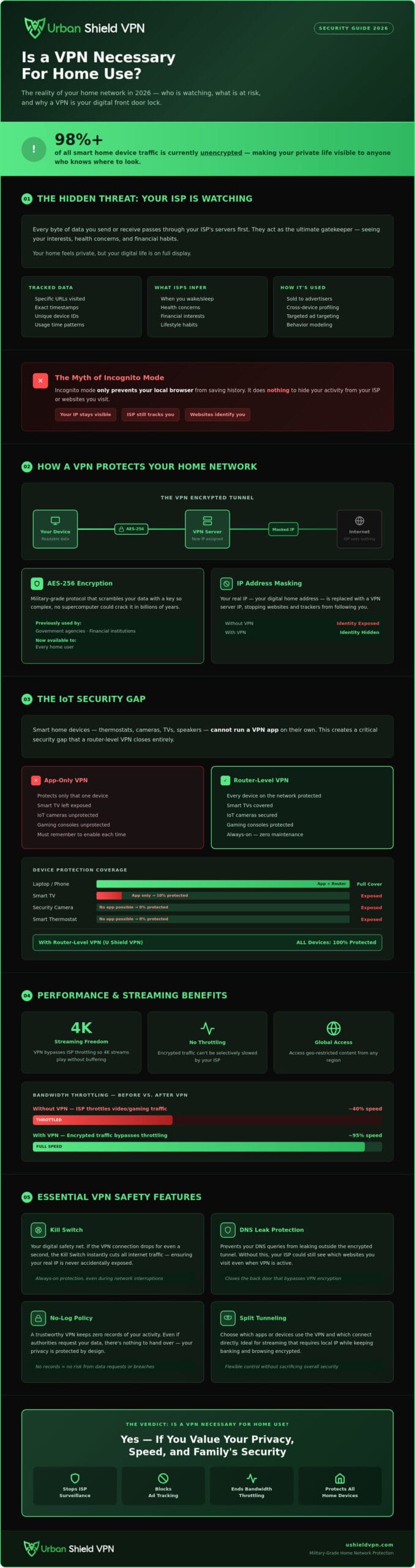
Over 98% of all smart home device traffic is currently unencrypted. This means your private life is often visible to anyone who knows where to look. You might ask, is a vpn necessary for home use if you already have a strong Wi-Fi password? It’s natural to feel safe behind your own front door. You expect your connection to be private and your 4K streams to be fast. However, the reality of 2026 is that your ISP is likely watching your every move and slowing your speeds when it suits them.
This article reveals why your home network is more vulnerable than you realize. You’ll discover how a VPN provides the ultimate silent guardianship for every device you own. We’ll break down how to stop intrusive tracking, bypass bandwidth throttling, and achieve complete peace of mind. It’s time to reclaim your digital freedom with a simple, set-and-forget security strategy that works in the background while you live your life.
Key Takeaways
- Reclaim your digital privacy from ISPs that track your every move at home.
- Discover why is a vpn necessary for home use to protect vulnerable smart devices that can’t run traditional apps.
- End bandwidth throttling and unlock the full potential of your 4K streaming and gaming.
- Master the difference between simple apps and hardware-based protection for total network coverage.
- Learn how military-grade encryption acts as a silent guardian for your family’s personal data.
The Hidden Reality of Home Privacy: Why Your ISP is Watching
Your living room feels like a private sanctuary. You close the blinds. You lock the door. Yet, your digital activity is often on full display. In 2026, the concept of “home” no longer guarantees privacy. Your Internet Service Provider (ISP) acts as the ultimate gatekeeper. Every byte of data you send or receive passes through their servers first. They see your interests, your health concerns, and your financial habits. It’s a level of access that most people wouldn’t grant to a stranger, yet it’s the standard for home internet.
This isn’t just about the websites you visit. It’s about the granular details. ISPs track specific URLs, exact timestamps, and unique device IDs. They know when you wake up and when you go to bed based on your data usage patterns. This constant surveillance makes many homeowners ask: is a vpn necessary for home use? When your primary connection point is also your primary observer, the need for a “Silent Guardian” becomes obvious. A Virtual Private Network (VPN) creates a secure, encrypted tunnel that hides this information from the very company you pay for internet access. It’s about taking back control of your own data.
Data Harvesting and Your Digital Profile
Your browsing habits aren’t just logged; they’re frequently monetized. ISPs often package your digital behavior into detailed profiles to share with third-party advertisers. This is why you see targeted ads for products you only recently researched. These ads follow you across devices, creating an intrusive digital experience that feels like you’re being followed. Metadata is the blueprint of your personal life. It tells a story of who you are, where you go, and what you value, all without anyone ever reading a single private message. By encrypting your traffic, you break this link and stop the harvesting process at the source.
The Myth of Incognito Mode
Many users rely on “Incognito” or “Private” windows to stay hidden. This is a dangerous misunderstanding of how network privacy works. Incognito mode only prevents your local browser from saving your history. It does nothing to hide your activity from your ISP or the websites you visit. Your IP address remains a visible beacon for trackers and data collectors. Without active encryption, you’re still broadcasting your identity to the entire network. To truly “go dark” at home, you must encrypt the connection itself. This turns your readable data into gibberish, ensuring your private life stays private.
How a VPN Secures Your Digital Life at Home
Think of a VPN as a private, armored tunnel built directly through the public internet. Your data enters one end as a readable stream of information. It emerges at the other end exactly as intended. To anyone trying to peek inside that tunnel, your activity is completely invisible. Understanding this fundamental technology helps clarify why many people conclude that is a vpn necessary for home use to maintain true privacy. It’s not about hiding from the law; it’s about closing the curtains on your digital life.
Military-Grade Encryption: Your Data’s Bulletproof Vest
Security used to be complex and cumbersome. Today, it’s a silent background process. The gold standard for modern protection is AES-256, often called military grade encryption VPN technology. In simple terms, this protocol scrambles your data using a key so complex that even the world’s most powerful supercomputers couldn’t crack it in billions of years. This level of security was once reserved for government agencies and top-tier financial institutions. Now, it’s your personal bulletproof vest. It ensures that even if a hacker or your ISP intercepts your data, they’re left with nothing but unreadable gibberish. This provides a deep sense of peace of mind, knowing your banking details and private conversations are physically impossible to decipher.
Hiding Your IP Address to Stop Targeted Tracking
Your IP address is your digital home address. It reveals your general physical location and identifies your specific internet connection to every website you visit. This information allows companies to build a permanent profile of your habits, preferences, and lifestyle. An FTC staff report on ISP data collection highlights just how much personal data is harvested through these identifiers. A VPN masks your real IP address, replacing it with one from a secure server. This simple switch stops websites from following you around the web. You gain the freedom to browse without being haunted by yesterday’s search history or targeted by intrusive advertisements.
Beyond encryption and masking, modern security tools offer two essential layers of protection:
- The Kill Switch: This is your digital safety net. If your VPN connection drops for even a second, the Kill Switch instantly cuts your internet access. This prevents your real data from leaking onto the public web by accident.
- Anti-Trackers: These tools strip away the “digital crumbs” websites try to leave on your devices. They block the hidden scripts that monitor your clicks and mouse movements.
If you’re looking for an effortless way to implement these protections, the U Shield VPN App provides a streamlined, one-tap solution for all your personal devices. It takes the technical burden off your shoulders, acting as a silent guardian for your digital home.
The IoT Security Gap: Protecting Devices That Can’t Run Apps
Your smartphone and laptop are likely secured. But what about your thermostat? Your smart doorbell? These devices are the “Weakest Links” in your home network. Most IoT (Internet of Things) devices are designed for convenience, not security. In fact, 2026 research confirms that 98% of all IoT device traffic is unencrypted. This creates a massive vulnerability. If a single device is compromised, your entire network is exposed. This reality often leads homeowners to ask: is a vpn necessary for home use if you have dozens of connected devices? The answer lies in creating a secure perimeter. You need network-wide VPN protection to cover the gadgets that can’t protect themselves.
Smart TVs and the Privacy Trade-off
Smart TVs are essentially data-harvesting machines. They track your viewing habits to serve targeted ads. They monitor what you watch and for how long. Most proprietary TV operating systems don’t allow you to install security software. You can’t just download a protective app to your television. This makes them a permanent blind spot. The solution is “plug and play” security. By securing the connection at the router level, you protect the TV without needing to change its settings. It’s a simple way to stop the tracking and reclaim your living room’s privacy.
Closing the Door on Smart Home Hacking
Every connected light bulb is a potential entry point. Bad actors don’t always target your bank account directly. They look for the easiest way into your Wi-Fi. Once they control a single smart device, they can often access the rest of your network. Routers are currently the target of over 75% of IoT attacks. This is why is a vpn necessary for home use becomes a question of total home safety. You need a secure perimeter for the entire house. The U Shield VPN Router offers an effortless way to prevent smart home hacking. It acts as a silent guardian. It encrypts every bit of data leaving your home, regardless of the device. No complex DIY fixes. No risk of “bricking” your hardware. Just total protection for every connected device in your home.
Performance and Freedom: Streaming and Gaming Benefits
A common myth persists: security kills speed. For years, users believed they had to sacrifice performance for privacy. In 2026, high-speed global servers have flipped this script. Today, a VPN is often the key to unlocking the true potential of your fiber or 5G connection. If you’ve ever wondered is a vpn necessary for home use when you’re already paying for premium bandwidth, the answer lies in how your ISP manages your data behind the scenes. Protection and performance are no longer mutually exclusive.
Ending Bandwidth Throttling for 4K Streaming
ISPs often use a technique called “Deep Packet Inspection” to monitor your activity. When they detect high-bandwidth tasks like 4K movie streaming or large file downloads, they may intentionally limit your connection speed. This saves them money on network infrastructure but leaves you with a spinning buffer wheel. By using a VPN for streaming, you wrap your traffic in a layer of encryption. Your ISP sees that you’re online, but they can’t identify the type of content you’re consuming. They can’t throttle what they can’t see. This ensures you enjoy the consistent, high-speed experience you actually pay for every month.
Accessing Global Content Safely
Digital borders can be as restrictive as physical ones. Regional blocks often prevent you from accessing the content libraries you enjoy. A dedicated, streaming-optimized server allows you to virtually travel. You can access your home accounts while traveling abroad or explore international catalogs from the comfort of your couch. These servers are engineered for velocity. They maintain the high bitrates required for Ultra-HD quality while bypassing geographic restrictions effortlessly. It’s about total entertainment freedom without the technical friction.
Gamers face a different set of challenges where every millisecond counts. Latency is the difference between winning and losing. Modern VPN protocols like WireGuard are designed to minimize lag, often providing a more direct route to game servers than your standard ISP path. Additionally, a hidden IP address provides a vital shield against DDoS attacks. Competitive gaming in 2026 requires this level of security to prevent frustrated opponents from knocking you offline. Is a vpn necessary for home use if you only play casually? It’s a matter of uptime and stability. A secure connection ensures your hobby remains uninterrupted by external threats or local network congestion.
Ready to reclaim your bandwidth? Secure your connection and boost your speeds with the U Shield VPN App.
Implementing Home Security Without the Technical Stress
Digital security shouldn’t feel like a second job. You want protection that works without constant management or manual updates. When deciding is a vpn necessary for home use, the final hurdle is often the perceived complexity of the setup. Many people assume they need a degree in networking to stay safe in 2026. This is no longer the reality. Modern solutions are designed to be approachable and effortless. You can choose between a flexible app-based approach or a robust hardware solution, both of which provide military-grade encryption with minimal friction.
VPN Router vs. VPN App: Which is Right for You?
Apps are perfect for your smartphone, tablet, or laptop. they provide security while you’re mobile and allow for quick server switching. However, a central hub offers a more comprehensive shield for the entire family. A VPN app vs VPN router hybrid setup is often the most effective strategy. You use the app for mobile devices and the router as the foundation for your home network. Crucially, a VPN router protects devices that don’t even have a screen. This includes your smart sensors, smart plugs, and even your connected kitchen appliances. It removes the need to log in to every individual device. One login at the source provides total, network-wide protection for everything connected to your Wi-Fi.
U Shield VPN: The Silent Guardian for Your Entire Home
We believe security should be invisible. It should act as a silent guardian that operates quietly in the background. The pre-configured VPN router from U Shield fulfills this promise. It arrives at your door ready to work. You don’t need to flash custom firmware or navigate complex, intimidating menus. Our “Plug and Play” promise means you can secure your entire home in under five minutes. We’ve taken the technical burden off your shoulders so you can focus on what matters most. It’s an efficient way to take back your digital freedom without any of the traditional stress.
Ultimately, the question of is a vpn necessary for home use comes down to your desire for peace of mind. If you want a faster, unrestricted, and truly private digital life, the solution should be a background process, not a chore. By moving the security to the network level, you ensure that every guest, every device, and every data packet is protected by default. It is the simplest path to a secure home in an increasingly connected world. Reclaim your digital sanctuary and enjoy the web the way it was meant to be: open, fast, and entirely yours.
Take Control of Your Digital Sanctuary
Your home is your sanctuary. It should stay that way. As we have explored, the digital reality of 2026 makes privacy difficult without the right tools. Your ISP acts as a constant observer. Your smart devices often serve as open doors for data harvesters. By now, the answer to is a vpn necessary for home use is clear. It is the essential foundation for a private, unrestricted, and secure household. You deserve a connection that works for you, not for advertisers.
You don’t need to be a technical expert to shield your family. With military-grade AES-256 encryption and hardware optimized for 4K streaming and low-latency gaming, you can enjoy total freedom without sacrificing speed. Our plug-and-play solution makes security effortless. It’s time to move from digital uncertainty to absolute peace of mind. Secure your entire home network with the U Shield VPN Router today.
Reclaim your digital space. Experience the internet with the confidence and speed you deserve. Your privacy is a right, not a luxury.
Frequently Asked Questions
Is it worth having a VPN at home if I only use my own Wi-Fi?
Yes. It is essential for true privacy. Your Wi-Fi password only secures the local connection; it doesn’t hide your activity from your Internet Service Provider. Without a VPN, your ISP can monitor every site you visit and sell that data to third-party advertisers. Is a vpn necessary for home use if you value your digital footprint? Absolutely. It provides the only way to ensure your private life stays off the market.
Does a VPN at home protect my smart home devices like cameras and TVs?
Yes, provided you use a hardware solution. Most smart TVs and cameras lack built-in security features and cannot run traditional apps. By encrypting your entire network at the source, you shield these vulnerable devices from hackers. This prevents bad actors from accessing your cameras or tracking your viewing habits. It turns your router into a silent guardian for every connected gadget in your house.
Will using a VPN at home slow down my streaming or gaming speeds?
Not necessarily. Modern protocols are designed for maximum velocity. While any encryption adds a small amount of overhead, a VPN often prevents ISP throttling. Your provider can’t slow down your 4K stream if they can’t see what you’re watching. You get the high-speed experience you pay for. This ensures buffer-free evenings and stable, low-latency gaming sessions without the technical friction.
Can my ISP see that I am using a VPN at home?
Your ISP can see that you’re connected to a VPN server. However, they cannot see your actual browsing data or the specific websites you visit. All your traffic is scrambled into unreadable code. This removes their ability to build a digital profile on you. They see the connection, but they lose the insight into your personal life, habits, and interests.
Is a VPN necessary if I only visit secure (HTTPS) websites?
Yes. HTTPS protects the specific data you enter on a site, but it doesn’t hide the domain name from your ISP. They still know you visited a specific bank or medical site. A VPN hides the destination itself. This adds a critical layer of invisibility that HTTPS simply cannot provide. It ensures your entire digital journey remains confidential from start to finish.
What is the easiest way to set up a VPN for my entire house?
The most effortless approach is using a pre-configured router. Manually installing apps on every phone, laptop, and TV is a chore. A plug-and-play router secures your entire network at the source. You set it up once and every device is protected automatically. This saves time and removes the technical stress of managing multiple logins. It’s the ultimate set-and-forget solution for modern families.
Can one VPN subscription protect every device in my home?
Yes. While most plans allow for multiple simultaneous app connections, a VPN router counts as just one device. This allows you to protect an unlimited number of smart devices, consoles, and laptops under a single subscription. It’s a highly efficient way to manage your home security. You gain complete coverage for the entire family without worrying about device limits or complex configurations.
Is a VPN router better than just using an app on my phone?
They serve different purposes but work best as a team. An app is perfect for security on the go. However, a router is superior for home use because it covers app-less devices like thermostats and smart TVs. Is a vpn necessary for home use at the router level? It is if you want total peace of mind. A router ensures no device is left vulnerable, providing a permanent shield for your sanctuary.
